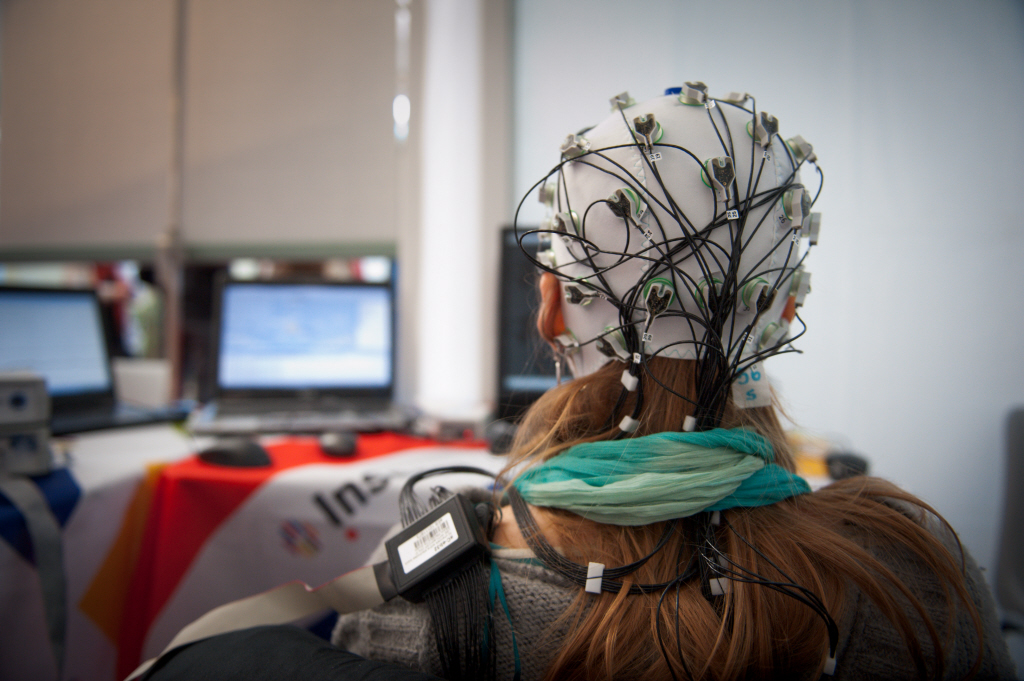
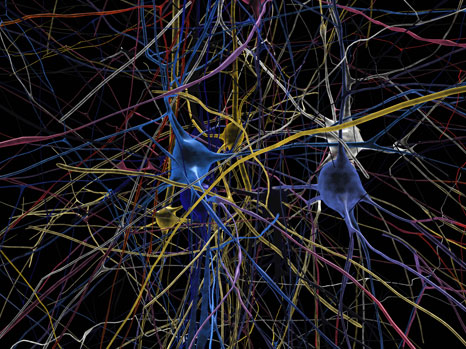
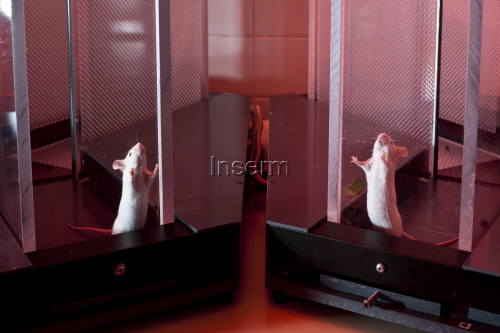
Researchers have designed a system for sensing brain activity that is 100% biocompatible and made of organic matter. The medium, which is only a few microns thick, is as thin and flexible as cellophane, and yet very tough. The model was tested on an animal suffering from epilepsy. The quality of the brain signal recorded was 10 times better than the traditional brain activity recording systems
An international group of researchers has discovered seven new regions in the human genome associated with an increased risk of developing age-related macular degeneration (AMD), one of the main causes of blindness.
The iCub humanoid robot on which the team directed by Peter Ford Dominey, CNRS Director of Research at Inserm Unit 846 known as the “Institut pour les cellules souches et cerveau de Lyon” [Lyon Institute for Stem Cell and Brain Research] (Inserm, CNRS, Université Claude Bernard Lyon 1) has been working for many years will now be able to understand what is being said to it and even anticipate...
Comment la recherche sur le syndrome de Usher – handicap héréditaire particulièrement invalidant, portant atteinte aux deux sens majeurs, l’audition et la vision – a-t-elle franchi une étape majeure dans la compréhension des mécanismes à l’origine de la rétinopathie pigmentaire ? Comment est-elle parvenue à améliorer le diagnostic clinique et à développer le diagnostic moléculaire ? Comment prépare-t-elle les essais de thérapie génique de la rétinopathie du syndrome ?...
The movement of molecules in the neuron extensions known as axons is a process that is vital for the survival of cells and the smooth operation of the nervous system. It is performed by vesicles that travel fast thanks to the energy-hungry molecular engines. At the “Signalling, neurobiology and cancer” Laboratory (Institut Curie/CNRS/Inserm) at the Institut Curie, the team headed by Frédéric Saudou , INSERM Director of Research, has...
La Commission européenne a officiellement désigné le Human Brain Project (HBP) comme l’un de ses deux projets FET Flagship. Le HBP regroupera les scientifiques de tout le continent autour de l’un des plus grands défis de la science contemporaine: comprendre le cerveau humain.
OpenViBE2 (2009-2013) is a collaborative research project, supported by finance from the ANR, that is based on the potential of the technologies known as “brain-computer interfaces”(ico) in the field of video games.This is a project that has brought together the scientific expertise needed through a multi-disciplinary consortium consisting of nine partners – the university laboratories who pioneered the field (INRIA, INSERM, cea, GIPSA-Lab), well-known video-game manufacturers (ubisoft, blacksheep studio,...
Connue pour être responsable de la maladie de Huntington, une maladie neurodégénérative, la protéine huntingtine mutée est également impliquée dans la progression et l’agressivité des tumeurs mammaires. C’est le résultat des études menées par l’équipe de Sandrine Humbert[1], directrice de recherche Inserm à l’Institut Curie, et publiées le 9 janvier 2013 dans le journal EMBO Molecular Medicine. Au niveau cellulaire, la protéine huntingtine mutée empêche le bon fonctionnement du...
Researchers from Inserm and the Université Lille/Université Lille Nord de France have recently used a neurodegeneration model of Alzheimer’s disease to provide experimental evidence of the relationship between obesity and disorders linked to the tau protein.
Physical inactivity is a major public health problem that has both social and neurobiological causes. According to the results of an Ipsos survey published on Monday 31 December, the French have put "taking up a sport" at the top of their list of good resolutions for 2013. However, Francis Chaouloff, research director at Inserm's NeuroCentre Magendie (Inserm Joint Research Unit 862, Université Bordeaux Ségalen), Sarah Dubreucq, a PhD student...