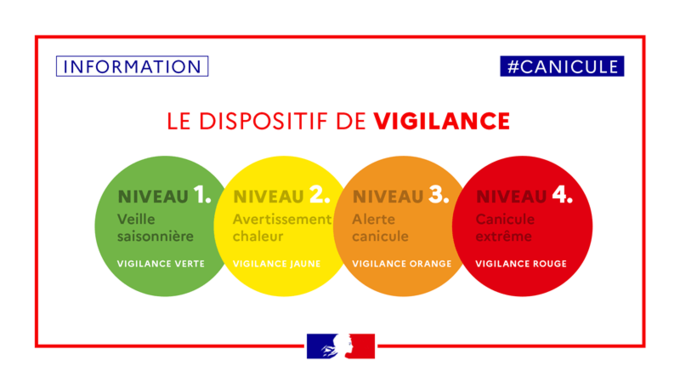
The alert system has four levels. © Government
Rising temperatures and the increase in extreme heat events—which are becoming more intense and longer-lasting—have been identified as a major public health issue, threatening vulnerable populations and placing growing pressure on health care systems. Following the 2003 heat wave, France established a national warning system designed to trigger local preventive measures to protect vulnerable populations. In a new study, researchers from Inserm, EHESP, and the University of Rennes, in collaboration with the University of Bern and an international team[1], evaluated the effectiveness of this system in reducing mortality. They analyzed nearly 2.5 million deaths that occurred in the 96 departments of metropolitan France during the summers of 2004 through 2022. By comparing alert days to days with similar temperatures but no alerts, the teams observed a decrease in mortality, which was particularly pronounced among people aged 85 and older. However, this effect diminishes when alerts occur in succession during the same summer. The results are published in the journal Environmental Health Perspectives.
The 2003 European heat wave highlighted the devastating potential of extreme heat, triggering widespread health crises and causing tens of thousands of deaths across the continent. France was among the hardest-hit countries: between August 1 and 20, 2003, approximately 15,000 excess deaths were recorded nationwide, a third of which occurred in the Paris region alone.
In response, France, like other European countries, established a national heat wave health alert system[2] (see box below) and a heat wave health action plan[3] to protect vulnerable populations from extreme heat waves.
The warning system classifies each French department into one of the following four levels of weather monitoring: green (normal summer temperatures), yellow (unusually high temperatures that do not exceed warning thresholds or short-lived spikes), orange (heat wave, defined as temperatures exceeding the warning thresholds specific to each department), and red (extreme heat posing a high health risk). These alert levels are calibrated based on local weather conditions and historical mortality trends.
Each level triggers increasingly strict local measures in coordination with various local stakeholders: the green level requires no action; the yellow level triggers preventive communications; the orange level activates public health and institutional responses, including plans for hospitals and healthcare facilities, care for vulnerable individuals, outreach visits to isolated residents, urban cooling measures, etc. ; finally, the red level triggers a full-scale mobilization with enhanced measures and, if necessary, the postponement of school exams or major public events.
In this study, heat wave alert days correspond primarily to the orange or red levels.
For the first time, researchers have assessed the potential impact of the program on reducing heat-related mortality (all causes combined) across all 96 French departments during the summers of 2004 through 2022[4].
First, they tallied the number of heat wave alert days (orange or red alerts) recorded during the period. In total, 4,422 alert days were recorded between 2004 and 2022, including 4,225 orange alerts and 197 red alerts. The annual number of red or orange alerts varied significantly from year to year, ranging from zero in 2004, 2007, and 2014 to more than 800 in 2022. Heat wave alert days were less frequent in northwestern France, particularly in Brittany, Normandy, the Pays de la Loire, and Hauts-de-France. Conversely, they were particularly frequent in the departments of the Rhône-Alpes region.
“During the first decade of the study period, heat wave alerts were relatively infrequent. Their number then increased significantly starting in 2015. The highest numbers were observed in 2019 and 2022, with 810 and 822 alert days, respectively. This increase reflects the growing frequency and duration of extreme heat episodes during the study period,” notes Hicham Achebak, the study’s lead author and a researcher at the Institute of Social and Preventive Medicine at the University of Bern.
This data was then cross-referenced with data on the 2,462,651 deaths that occurred during the period (date of death and place of residence)[5], as well as with daily temperature readings in each region.
The research team also compared days for which a heat wave alert was issued with days without an alert but with similar temperatures in the same department and during the same period. This comparison allowed the team to assess the additional benefit associated with triggering the alert system, independent of the effect of the heat.
“This study adopted a novel method based on the comparison of mortality between matched heat alert and non-alert days with similar temperatures. This clever design helps isolate the contribution of the alerts in reducing risks for the population”, explains Antonio Gasparrini, Professor of Biostatistics and Epidemiology at the London School of Hygiene & Tropical Medicine, one of the authors of the study.
Statistical analyses were then conducted on all-cause mortality and repeated separately by sex (men and women) and by age group (0–64 years, 65–74 years, 75–84 years, and ≥ 85 years) to obtain estimates specific to each subgroup.
Heat wave alert days were associated with a decrease in all-cause mortality in most age and sex groups, with the largest reduction observed among adults aged 85 and older. For this age group, mortality was 3.70% lower thanks to the alert systems.
The study also shows that the association between heat wave alerts and reduced mortality weakens over successive episodes. The reduction in mortality is, in fact, more pronounced during the first alert episode of the year, while subsequent episodes are associated with less significant effects.
“One possible explanation for this phenomenon is that the first warnings attract more public attention and elicit more pronounced behavioral responses than subsequent warnings, although differences in the characteristics of successive heat wave episodes may also play a role,” explains Hicham Achebak.
“Our study shows that the French heat wave warning system is associated with a reduction in all-cause mortality. However, the effectiveness of the various preventive measures implemented locally still needs to be identified and evaluated in order to better tailor them to the specific characteristics of each region and the needs of the population. Furthermore, the health impact of a heat wave also depends on factors such as the time of year and air pollution. These results call for more dynamic warning systems capable of taking these various factors into account.” concludes Tarik Benmarhnia, co-author of the study, professor at the École des hautes études en santé publique, and head of an Inserm team (CITES) at the Institute for Research in Health, Environment, and Work (IRSET) and the University of California, San Diego (USA).
[1] This research is the result of an international collaboration between researchers at the Institute for Research on Health, Environment, and Work (IRSET) (Inserm, EHESP, University of Rennes) and international partners (University of Bern, UC San Diego, and the London School of Hygiene & Tropical Medicine).
[2]https://www.santepubliquefrance.fr/climat/fortes-chaleurs-canicule/rapportsynthese/systeme-dalerte-canicule-et-sante-principes-fondements-et-evaluation
[3]https://www.santepubliquefrance.fr/determinants-de-sante/climat/fortes-chaleurs-canicule/documents/rapport-synthese/canicule-dispositif-d-alerte-et-de-surveillance-et-dispositif-de-prevention-de-sante-publique-france
[4]Period from June to September
[5] Data provided by the Center for Epidemiology of Medical Causes of Death (CépiDc) at Inserm.
These contents could be interesting :
 The alert system has four levels. © Government