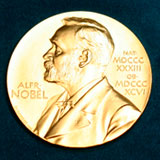
The Nobel Prize of physiology or medicine 2013 is awarded to James Rothman, Randy Shekman et Thomas Südhof for their work about vesicular transport in cells.
Comments available on our twitter account : @Insermlive
Catégorie de C est dans l air: France
September 29th, 2013 : World Heart day
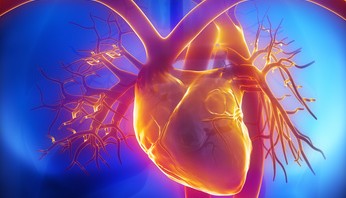
On the occasion of the world heart day, Inserm offers a selection of researchers available to answer your questions on the latest studies.
Photo:
© Fotolia
Man & robot : The Interspeech 2013 – August,28th – Lyon
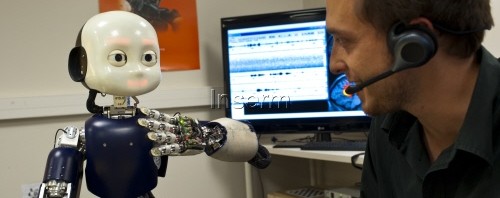
At the IUT GMP of Lyon 1 University, researchers for the first time were able to teach an industrial robot how to perform new tasks, by explaining the task in spoken language. Combining forces from cognitive neuroscience and industrial robotics, Peter Ford Dominey (INSERM/CNRS) and Sébastien Henry (Univ Lyon 1) made the link between language and robot commands. This may be the first step towards allowing smart robots to interact with non-experts in the factory. And this may be a step in boosting the competitivity of French PMEs.
M. Dominey and his colleagues will talk about interaction between men and robots during a pau sujet de l’interaction the Interspeech conference in Lyon, Wednesday 28 august (special session « Show and Tell », Wednesday 28 August, 2-4 pm).
“On-Line Learning of Lexial Items and Grammatical Constructions via Speech, Gaze and Action-Based Human-Robot Interaction”
Gregoire Pointeau, Maxime Petit, Xavier Hinaut, Guillaume Gibert, Peter Ford Dominey, Interspeech 2013, Lyon.
See the process that give robots the ability to execute several tasks, thanks to the human voice :
Cardiac tissue from stem cells
Reprogrammed stem cells have made it possible to grow functional heart tissue in the laboratory, according to a study published on Tuesday in the magazine Nature Communications.
A team from the University of Pittsburgh (Pennsylvania, United States) used pluripotent induced stem cells (iPS), taken from adult human skin cells, and reprogrammed them to obtain precursors of the heart cells known as “MCPs”.
The cells that were created were able to replicate the structure of a rodent’s heart, according to the researchers.
To comment on this work, please contact Philippe Menasche.
August, 13th : World Left-handers Day

credit : © Fotolia
A left-hander has sensory and motor organs that are more developed on the left side, yet it is the right hemisphere of his/her brain that is dominant, the reverse of right-handed people. Physiological, hereditary and environmental factors explain the predominance of the left side in individuals.
According to the World Left-handers Days site, left-handers represents about 12% of the population throughout the world.
Did you know?
World Left-handers Day was introduced in 1976 and the lesgauchers.com website is responsible for organising left-handers in France.
Please consult the latest progress of our teams on this subject (February, 2012) : When your left hand mimics what your right hand does: it’s in the genes
Return of the hot weather in France

For the last few days France has been experiencing high temperature peaks, reaching 40 degrees in certain regions.
Even if from a meteorological point of view this is not classified as a heat wave, vigilance messages are multiplying and these are aimed at sections of the population that are most at risk, inviting them to exercise caution.
People are advised to drink plenty of water, to avoid intense effort and to stay indoors in the coolest rooms in order to avoid discomfort, dehydration, etc.
For more information about the risks connected with high heat and especially dehydration, please contact Monique Ferry, researcher at INSERM Unit U557 Nutritional Epidemiology.
For the mortality figures linked to the 2003 heat wave:
CépiDc (Centre d’épidémiologie sur les causes médicales de décès)
Grégoire Rey
01 45 59 18 63[/complement]
Sport and disability: a training plan for paraplegics
One year after the success of the Paralympic Games in London, France will be hosting the World Handisport Athletics Championships this Friday 19 July in Lyon (lasting until 28 July, the World Handisport Athletics Championships.
In Dijon, Gaëlle Deley, scientific officer of the Centre d’Expertise de la Performance and associate researcher in Inserm Unit 1093 “Cognition, action, sensory-motor plasticity” and her team have developed an innovative training technique for paraplegics.
In fact, if they are to be effective for health, sports exercises need to reach a certain intensity but this poses a problem for paraplegics. That is because their bodies do not generally work out hard enough because they can only use their upper limbs. This affects their health since the main causes of mortality among paraplegics are cardiovascular diseases.
By using a rowing machine combined with electrical stimulation, the patient is able to perform the same movements as an able-bodied sportsperson. This procedure mobilises all the muscles in the body and is aimed at increasing the physical capacities and quality of life for a wheelchair-bound person.
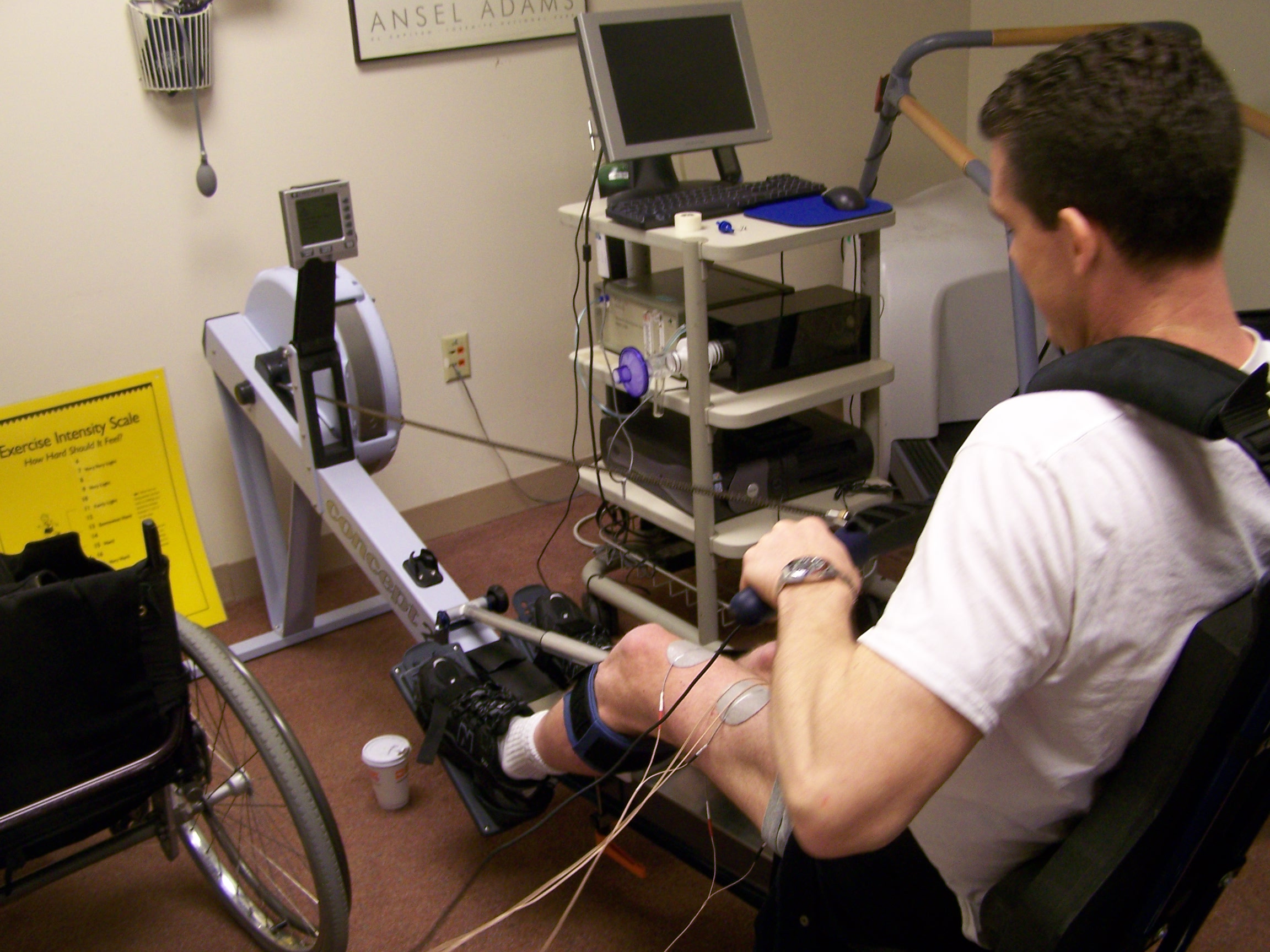
crédit : ©Gaëlle Deley
The patient sends an electrical current to his/her thighs via electrodes. This causes the muscles to contract and propel the chair backwards. When the electric current is cut, the action of the upper limbs moves the chair forwards.
This programme, developed in close collaboration with Harvard University, has already taken on considerable magnitude in the United States. “The purpose is to look at our results and progress together. If the health benefits are confirmed, this method could be developed on a larger scale”, explains the scientific officer.
The initial results are very encouraging: the physical capacities of the patients have improved by nearly 40% after only a few months.
“Apart from the health benefits, this method is of great interest to the paraplegic sportsperson, regardless of the sport practised, because this makes it possible to train at much greater intensity and thus to develop physical abilities to a much greater extent”.
For more information about the study currently in progress, please contact Gaëlle Deley.
Bill about embryonic stem cells

Inserm/Bruno Lassalle
The bill to end the ban on research into embryos and embryonic stem cells that was hotly disputed last March is being debated again today in the National Assembly. The status of the embryo is discussed.
This type of research has been banned in France unless special permission is received. (Consult the list of research teams authorised to work on embryonic stem cells).
In recent years, research into human embryonic stem cells (ES) has developed considerably. In fact, the ability to reproduce embryonic stem cells indefinitely and differentiate them into any of the cells of which the human body consists has caused researchers to show greater interest in them.
For the opponents of the bill, the fact remains that the human embryo represents a period in the development of a human being.
For more information about embryonic stem cells, please contact Marc Peschanski, Scientific Director of I-Stem (Stem Cell Institute for the Treatment and Study of Monogenic Diseases).
Consult last news about human embryonic stem cell
Identification of a recurrent chromosomal anomaly in neural cells derived from pluripotent stem cells (ES and iPS)– 25 janv 2012
The infection affecting Nelson Mandela
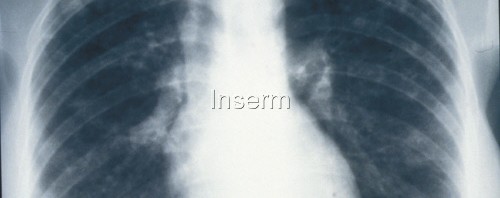
Inserm
The lung infection from which Nelson Mandela has suffered for several years lodges in an essential part of the human organism, the lungs and bronchiae. Pneumonia, pneumopathy and pulmonary abscesses are the main pulmonary infections so far identified.
In the vast majority of cases, these infections are due to viruses, microbes or bacteria that infiltrate into the lungs and, depending on the level of resistance, cause disorders of the respiratory tract.
The part of the lung that becomes infected will determine which disease affects the patient. The commonest symptoms of infection are coughing, breathlessness and respiratory failure.
Pulmonary infection may sometimes have very serious consequences. Such an infection can cause serious breathing difficulties and can also damage the broncho-pulmonary system. The elderly are particularly vulnerable.
For more information, please contact Camille Locht, Director of the Inserm unit “Lille Infection and Immunity Centre”.
Medicines’ Sale via the Internet

©M.Depardieu/Inserm
Online sales of medicines have been permitted in France since 19 December 2012. The online sale of medicines will now become strictly regulated in order to avoid any trade in counterfeit goods.
The order that came into force on 12 July 2013 specifies that sites that are entitled to sell medicines online must be the “virtual extension” of a physical pharmacy which is itself authorised. Notices of each medication (specifying the doses, usage precautions, etc.) must be available online and be printable.
The list, which has been judged to be too restrictive by the Council of State and the Autorite de la Concurrence, contains 450 medicines but has now been extended to any medication that does not require a medical prescription.
Marisol Touraine, Minister of Health, reaffirmed that “prescription medicines cannot be sold on line in order to avoid both counterfeiting and to ‘reassure’ the French people”.
For more information: Maryse Lapeyre-Mestre, of the Inserm unit 1027 “Pharmacoepidemiology”.
And you can read the paragraph about the cyberpharmacy in the collective expert report “Psychoactive drugs : consumption and drug dependance” (page 61 à 69) (available only in French)
National Conference On Violence Against Children
Violence against children is not just another mere news item. It is a major public health problem. As in other countries that have a similar level of socio-economic development1, 10% of children in France are victims of physical violence, sexual abuse, serious negligence, neglect, humiliation, etc.
Today, around two children die each day because of violence related issues involving adults.
Contrary to other children’s health issues, such as domestic accidents, sudden infant death syndrome, etc., that are of prime concern and have been the focus of vigorous policies, in France, violence against children has not to this day been the subject of any major prevention policies.
Despite the law proposed in 2007 to amend child protection rights, a number of problems regarding this issue still remain. A report from the Cours des Comptes (the French national audit office), published in October 2009, revealed significant geographical disparities and a lack of detailed assessment.
These reports in particular have led the French Senator André Vallini, supported by a scientific committee directed by the paediatrician, epidemiologist and Research Director at Inserm, Anne Tursz, to organise a conference aimed at raising general awareness on this issue and also establishing concrete measures, which will be proposed to public authorities.
Violence against children will be the the subject of a national conference that will be held on Friday 14 June 2013 at the Senate
Under the distinguished patronage of Mr. Jean‐Pierre Bel, President of the Senate, under the honorary chairperson and in the presence of Mrs. Valérie Trierweiler, with an introduction by André Syrota, the Chairman and CEO at Inserm.
If you wish to know more information, please contact Anne Tursz.