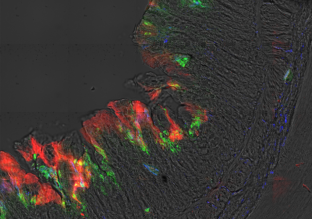
Atopic dermatitis, or eczema, primarily affects infants and children, and manifests itself in hypersensitivity to allergens in the environment. A skin disease characterized by flare-ups, it is often treated with topical anti-inflammatories. A new study shows that immune cells and sensory neurons interact in the skin to form units that can detect allergens and trigger inflammation. A discovery that provides an insight into how atopic dermatitis works, and points...
The 2019 Nobel Prize was awarded on Monday, October 7
Bacillary dysentery caused by the intestinal bacteria Shigella is a major health problem in tropical regions and developing countries. Complications from this infection lead to several hundred thousand deaths a year, primarily among infants. Researchers from Inserm and the Institut Pasteur have studied the mechanisms of Shigella virulence. They found that these bacteria are not only able to consume the oxygen in colonic tissue in order to grow and...
A study shows that intensive physical training can harm brain capacity, particularly cognitive control.
Chikungunya is characterized by high fever and intense joint and muscle pain that can last for several months. The mechanisms of infection of human cells with the virus remain very poorly understood. Led by Ali Amara in collaboration with Marc Lecuit researchers from Inserm, Institut Pasteur, CNRS and Université de Paris have identified a protein that is crucial in order for the virus to replicate within its target cells.
In a recent study, researchers managed to decipher certain pathways by which Escherichia coli Nissle 1917 produces both beneficial and toxic compounds. They then successfully created a modified strain with the same probiotic properties but an unactivated version of the toxin.
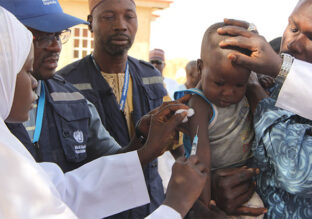
The World Health Organization (WHO) recommends a single dose of the yellow fever vaccine for individuals aged 9 months or older living in or traveling to areas at risk of disease transmission, but there is a lack of data on its long-term efficacy when administered to infants. José Enrique Mejía, Inserm researcher at Unit 1043 Center for Pathophysiology of Toulouse Purpan and Cristina Domingo from the Robert Koch Institute in Berlin...
Samedi 21 septembre 2019 : 26e Journée Mondiale de la maladie d’Alzheimer
According to a new study morphological analysis of the cortical sulci could make it possible to identify Alzheimer's disease in 91% of cases.
Des équipes de deux centres majeurs de transplantation rénale de l’AP-HP (à l’hôpital Necker-Enfants malades et à l’hôpital Saint-Louis) et de l’Université de Paris, ont coordonné, au sein du « Centre d’expertise de la transplantation d’organe » de l’unité Inserm 970 dirigé par le Pr Alexandre Loupy, une étude internationale ayant permis d’élaborer et de valider iBox, le premier algorithme universel de prédiction du risque de perte de rein...
Alors que les méthodes d’apprentissage automatique sont utilisées dans de nombreux domaines, y compris la santé humaine, leur application au monde du vivant est peu explorée à l’échelle moléculaire. Des chercheurs de l’Inra et de l’Inserm, viennent de réaliser un premier pas dans cette direction en créant un réseau neuronal simple dans un extrait cellulaire de bactérie Escherichia coli.