

Researcher Contact
Claire Philippat
Inserm Researcher
U1209 Institute for the Advancement of Biosciences (Inserm/CNRS/Université Grenoble Alpes)
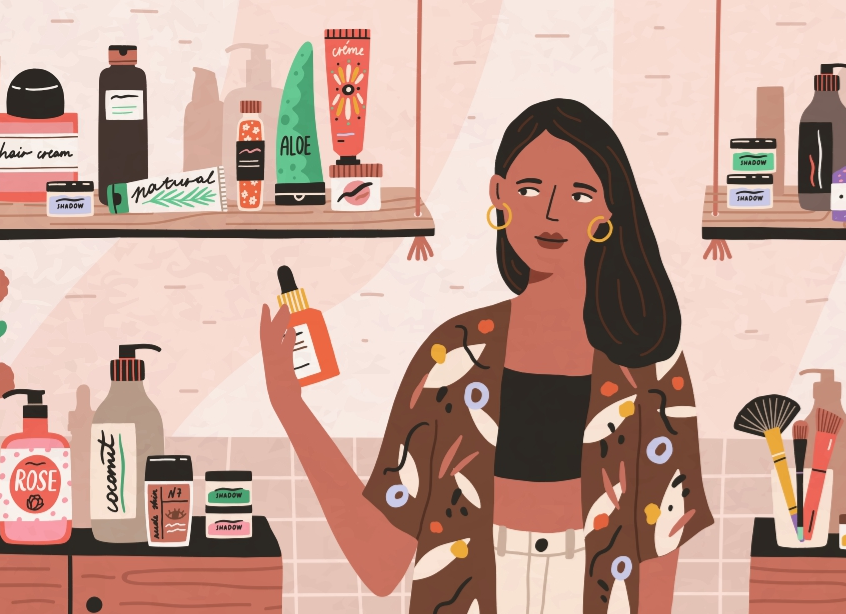 Researcher observed a nearly 40% decrease in urinary concentrations of bisphenol A (BPA), a substance classified as “of very high concern,” a known endocrine disruptor, and a suspected reproductive toxin by health authorities. © Adobe Stock
Using fewer cosmetics and skincare products can quickly reduce exposure to several chemicals, including known or suspected endocrine disruptors, according to a study published on April 7 in Environment International by researchers from Inserm, the University of Grenoble Alpes, and the CNRS, at the Institute for the Advancement of Biosciences, and supported by the European Commission. Conducted among about 100 female students, the study shows that reducing the number of cosmetics and skincare products used and opting for alternatives free of several compounds suspected of having adverse health effects (including methylparaben and certain phthalates) leads to a decrease in urinary concentrations of these substances in just five days. A decrease in bisphenol A concentration was also observed. This substance, classified by the European Union as “of very high concern,” is a proven endocrine disruptor and suspected reprotoxicant, now banned in cosmetics. For the first time in this type of study, the researchers conducted a health impact assessment to estimate the potential health and economic benefits of such a change in cosmetic routines at the population level.
Carcinogenic and reprotoxic substances are banned in cosmetics in Europe, but many substances found in hygiene products and cosmetics—such as certain phenols, phthalates, and methylparaben—are suspected of having harmful effects on health, particularly endocrine-disrupting effects. They could interfere with the hormonal system and, through this mechanism, be associated with potential effects on fertility and child development, particularly in cases of exposure during pregnancy.
To assess the extent to which the use of cosmetic and hygiene products influences exposure to these compounds, scientists from Inserm, Grenoble Alpes University, and CNRS at the Institute for the Advancement of Biosciences conducted a study[1] involving approximately 100 female students in Grenoble aged 18 to 30. For five days, they reduced the number of cosmetic products they used and, hygiene products such as soap, toothpaste or deodorant, were replaced with alternatives provided by the research team that were free of synthetic phenols, parabens, phthalates, and glycol ethers.
A comparison of urine concentrations before and after these five days of restricted cosmetic use shows a significant decrease in biomarkers of exposure to diethyl phthalate (-22%), used primarily as plastizicer to fix fragrances, and methylparaben[2] (-30%), a preservative and potential endocrine disruptor, according to European authorities. Propylparaben[3], another potential endocrine disruptor according to the same source, was also detected less frequently following the intervention.
“What’s interesting is how quickly these decreases are observed—in just five days. This was expected, given how quickly our bodies eliminate these substances. It’s encouraging, especially since these substances are suspected of affecting rethe endocrine system, health and development,” explains Nicolas Jovanovic, a doctoral student at the Grenoble Alpes University and the first author of the study.
Scientists also observed a 39% decrease in urinary concentrations of bisphenol A (BPA), a substance classified as “of very high concern” (SVHC, for Substance of Very High Concern), a proven endocrine disruptor and suspected reprotoxicant according to health authorities, and which may be present in certain containers for cosmetics and hygiene products.
“Bisphenol A is in not authorized as an ingredient in personal care and cosmetic products due to its reproductive toxicity. Its presence could be linked to contamination occurring during the manufacturing process or via packaging materials. “While Bisphenol A is restricted in materials that come into contact with food in Europe, this is not the case for materials used in containers for, cosmetic, and hygiene products,” explains Claire Philippat, Inserm researcher and the study’s last author.
For the first time in this type of study, researchers conducted a health impact assessment to estimate the potential health and economic benefits of such a change in cosmetic habits at the population level.
“Focusing on bisphenol A, we estimated that this change in cosmetic routine could prevent approximately 4% of asthma cases in children exposed in utero. These health benefits would also be accompanied by economic benefits, with potential savings of up to 9.7 million euros per year in treatment and hospitalization costs. These are hypothetical projections, but these results highlight the major public health implications of reducing exposure to these compounds,” adds Remy Slama, Inserm research director.
“Our results show that cosmetics contribute to exposure to substances associated with health risks, and that this exposure can be reduced by using fewer products and opting for hygiene products and cosmetics that do not contain these substances,” emphasizes Claire Philippat.
Beyond individual efforts alone, the authors also emphasize that regulatory measures regarding product composition and packaging would be more likely to sustainably reduce exposure across the entire population.
“In the absence of a mandatory logo indicating the presence of hazardous substances in cosmetics, it is very difficult for consumers to interpret product labels and avoid those containing substances of concern,” says Remy Slama.
“These findings underscore the importance of a strong regulation for chemicals in everyday consumer products to protect public health,” concludes Claire Philippat.
[1] This study was funded by Horizon Europe 2020 (Grant No. 874583, ATHLETE Project)
[2] https://edlists.org/search?search_api_fulltext=m%C3%A9thylparab%C3%A8n
[3] https://edlists.org/substance/propyl-4-hydroxybenzoate-propylparaben
Claire Philippat
Inserm Researcher
U1209 Institute for the Advancement of Biosciences (Inserm/CNRS/Université Grenoble Alpes)
Levers to decrease exposure to harmful chemicals: the case of Personal Care
Products and cosmetics
Nicolas Jovanovica, Franziska Brighta, Cathrine Thomsenb, Ronan Garlantezecc, Audrey Rocaboisa, Rosemary RC McEachand, Tiffany C Yangd, Amrit K Sakhib, Cécile Chevriere,Sandrine Mathyf, Rémy Slamag,h, Sarah Lyon-Caena, Martine Vrijheidi,j,k, Claire Philippata
a University Grenoble Alpes, Inserm, CNRS, Team of Environmental Epidemiology Applied to Reproduction and Respiratory Health, Institute for Advanced Biosciences (IAB), Grenoble, France
b Norwegian Institute of Public Health, Oslo, Norway
c Université de Rennes, CHU Rennes, Inserm, EHESP, IRSET (Institut de Recherche en Santé, Environnement et Travail) – UMR_S 1085, F-35000 Rennes, France
d Bradford Institute for Health Research, Bradford Teaching Hospitals NHS Foundation Trust, Bradford, UK
e Université de Rennes, Inserm, EHESP, IRSET (Institut de Recherche en Santé, Environnement et Travail) – UMR_S 1085, F-35000 Rennes, France
f Université Grenoble Alpes, CNRS, INRAE, Grenoble INP, GAEL, 38000 Grenoble, France
g SMILEteam,Institut de Biologie de l’ENS (IBENS), Ecole Normale Supérieure, Université PSL, CNRS, Inserm F-75005 Paris, France
h PARSEC (ParisResearchinHealth, Environment and Climate), Inserm and Ecole Normale Supérieure, Inserm F-75005 Paris, France
i ISGlobal, Barcelona, Spain
j Universitat Pompeu Fabra, Barcelona, Spain
k Spanish Consortium for Research on Epidemiology and Public Health (CIBERESP), Mad
Environment International, April 7, 2026