 © Inserm
France and Japan are joint leaders in improving global health. We share the same goals and possess long-standing, complementary scientific expertise. Deepening our scientific cooperation means contributing to the improvement of global health. French President Emmanuel Macron and Japanese Prime Minister Sanae Takaichi made that commitment in the Franco-Japanese Joint Declaration on Global Health, adopted in April 2026. France’s decision to open a regional office of the French Institute of Health and Medical Research (Inserm) in Tokyo gives concrete expression to this commitment and strengthens this outstanding partnership between our two countries.
Connecting, accelerating, and scaling up. These are the three pillars of the new strategic direction that Inserm aims to give to its international partnerships with Asia. Artificial intelligence, emerging diseases, healthy aging, and cancer—biomedical research must continue to expand and organize itself to respond as quickly as possible to global health challenges.
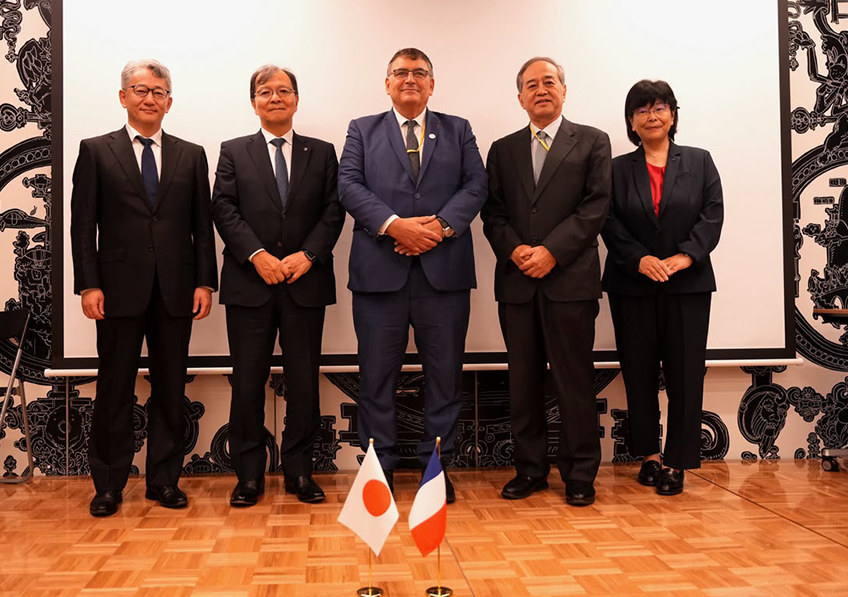
Four high-level Franco-Japanese scientific partnerships, embodying this new strategy, will be unveiled on October 2 in Tokyo at the French Embassy in Japan, on the occasion of the official opening of Inserm’s representative office in Asia. They will be signed by Didier Samuel, CEO of Inserm, and his Japanese counterparts: Kyoko Nozaki, Executive Vice President of RIKEN; Hiroshi Toshiyoshi, Director General of the Institute of Industrial Science at the University of Tokyo; Hitoshi Nakagama, President of the Japan Agency for Medical Research and Development; and Yoshito Oshima, President of the National Institute for Environmental Studies (NIES).
To symbolize this outreach to Asia, the 2026 Inserm International Prize will be awarded to Noboru Mizushima, a world-renowned Japanese researcher in the field of autophagy—a key cellular function that enables cells to eliminate unnecessary, defective, or toxic components and to recycle those that can be reused.
Japan, a strategic partner of Inserm
550: that is the number of annual Franco-Japanese scientific co-publications by Inserm, a figure that is rising rapidly (+27% since 2023).
The decision to open Inserm’s Asian representative office in Tokyo reflects the institute’s resolve to strengthen our cooperation with Japan and to contribute to the commitments made by our two countries. As an immediate manifestation of this resolve, four new agreements will be signed with prestigious partners on October 2, 2026, during a day of scientific and institutional exchanges organized by Inserm at the French Embassy in Japan:
- A comprehensive agreement with RIKEN, the national research and development agency;
- A comprehensive agreement with the Institute of Industrial Science at the University of Tokyo to combine expertise in organ-on-a-chip technology;
- An agreement with the Japan Agency for Medical Research and Development (AMED) aimed at facilitating research cooperation in areas of mutual interest: immunology, inflammation, infectious diseases, and microbiology;
- An agreement with the National Institute for Environmental Studies (NIES) to share data between the Japan Environment and Children’s Study (JECS) cohort and the France-Investigation Longitudinale sur les Maladies et l’Environnement dans l’Enfance (Filomene) cohort for research on the exposome and children’s health.
According to Professor Didier Samuel, CEO of Inserm, “Inserm maintains strong institutional ties with Japan, which are essential to its international activities. This office in Tokyo will enable us to strengthen existing scientific collaborations and forge new ones on particularly important health issues, such as children’s health and artificial intelligence.”
The French Ambassador, Béatrice le Fraper du Hellen, emphasizes that “six months after the President of the Republic’s official visit to Japan, the opening of the Inserm office in Tokyo adds another building block to our scientific partnerships with Japan. This marks a new milestone for France’s presence in Japan and for the reach of our collaboration in health research, which we know is essential to the future of our societies.”
According to Yoshito Oshima, President of NIES, “this agreement will advance our understanding of how environmental factors influence children’s health and development. Through exchanges regarding the Japanese Environmental and Children’s Study (JECS) and the French Filomene cohort, we will identify opportunities for collaborative research. Our shared goal is to generate evidence that will help create healthier environments for children in Japan, France, and beyond. ”
According to Kyoko Nozaki, Executive Vice President of RIKEN, “life science research conducted at RIKEN shares a common goal: to uncover the mechanisms that govern life and apply these discoveries to address global health challenges. By combining Inserm’s excellence in medical sciences with RIKEN’s strengths in life sciences and AI, we can drive innovation in the fields of health and medicine.”
Director General Hiroshi Toshiyoshi stated that “the Institute of Industrial Science places particular importance on international cooperation with Europe, especially with France. With the signing of this exchange agreement and the opening of the Inserm office in Tokyo, we expect to see a further acceleration of applied research in biology and medicine in the field of micro- and nanotechnologies.”
For AMED, “France is a world leader and a key partner in the field of medical and health research. With this agreement, AMED will deepen its collaboration with Inserm, thereby fostering joint research and exchanges among researchers. By combining the strengths and exceptional expertise of Japan and France, this will contribute to the creation of new scientific knowledge and the promotion of medical innovation.”
Scaling up:
This Tokyo office relies on partnerships that are already shaping the region. In Singapore, Inserm collaborates with the National University of Singapore, Nanyang Technological University, and A*STAR on aging, health technologies, and metabolic and infectious diseases. In China, cooperation with the Chinese Academy of Sciences on healthy aging is entering a new phase with the first exchanges of postdoctoral researchers. In Taiwan, the Franco-Taiwanese Center for Biomedical Cooperation, established with National Taiwan University, brings together collaborations in health technologies and oncology. Finally, in South Korea, recent exchanges with the Korea Research Institute of Bioscience and Biotechnology and the Korea Disease Control and Prevention Agency are opening up promising prospects.
About the Institute of Industrial Science at the University of Tokyo (UTokyo-IIS)
The Institute of Industrial Science at the University of Tokyo (UTokyo-IIS) is one of the largest university-affiliated research institutes in Japan. UTokyo-IIS comprises more than 120 research laboratories, each led by a faculty member, and brings together more than 1,200 members (approximately 400 staff members and 800 students) who are actively engaged in teaching and research. Its activities cover virtually all fields of engineering. Since its founding in 1949, UTokyo-IIS has strived to bridge the significant gaps that exist between academic disciplines and practical applications.
About the Japan Agency for Medical Research and Development (AMED)
Established in 2015, the Japan Agency for Medical Research and Development (AMED) is Japan’s leading funding agency for medical research and development. AMED provides continuous support throughout the innovation process, from basic research to clinical application, with the aim of advancing medical innovation. Through strategic international partnerships and collaborative research initiatives, AMED strives to promote the internationalization of medical research and development and to support efforts to address global health challenges.
About RIKEN
RIKEN is Japan’s leading multidisciplinary scientific research institute. Each year, more than 2,500 articles written by RIKEN researchers are published in leading scientific and technological journals, covering a wide range of disciplines, including physics, chemistry, biology, engineering, computer science, artificial intelligence, and medical sciences. RIKEN’s research environment, along with its strong emphasis on interdisciplinary collaboration and openness to the world, has earned it a global reputation for scientific excellence.
About the National Institute for Environmental Studies (NIES)
The National Institute for Environmental Studies (NIES) plays a central role in addressing environmental issues in Japan through integrated research covering a wide range of fields, both locally and globally. Researchers with diverse areas of expertise conduct interdisciplinary work, ranging from basic research to research aimed at solving complex environmental problems. More than 80 percent of NIES researchers hold a Ph.D.