Menu

FameLab: the scientific communication competition returns to France !

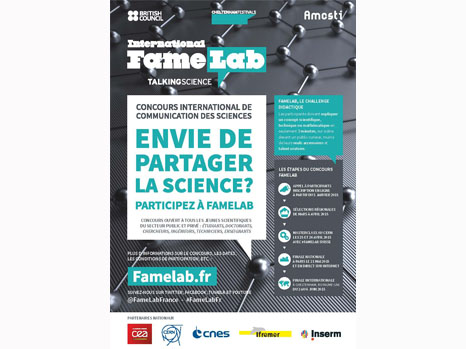
For the second consecutive year, FameLab, the international scientific communication competition organised by the British Council and its partners, is coming back to France !

Who is this competition for?


Whether you are a young researcher, student or teacher of science, FameLab invites you to present your chosen subject for three minutes to a panel of professionals from the communications, research and media sectors.

Three criteria need to be met: content, clarity and charisma!


How do you take part?


Heats will take place throughout France between March and April 2015 in partnership with scientific cultural organisations:
Brest, Océanopolis, Friday 6 March 2015 (closing date for entries 28 February 2015);
Marseille, Campus Saint-Charles, Tuesday 10 March 2015 (closing date for entries 3 March 2015);
Toulouse, Bazacle, Thursday 26 March 2015 (closing date for entries 13 March 2015);
Villeneuve d’Ascq, Forum des Sciences, Saturday 4 April 2015 (closing date for entries 4 March 2015);
Bordeaux, Cap Sciences, Friday 10 April 2015 (closing date for entries 10 March 2015);
Paris, venue and date to be announced in February

The national final will take place on 21 May in Paris.

Unavailable for the regional heats? You can submit a video entry.

Participation in FameLab also means:

An opportunity for the participants:
– to interact with other science enthusiasts and enjoy networking with FameLab candidates from France and around the world;
– to benefit from the informed opinions of recognised specialists;
– to publicly present the results of research, and share their passion for science.

Winners will receive:
– A two-day Masterclass at CERN (European Organization for Nuclear Research) in Geneva in order to refine their oral presentation technique and communication skills;
– For the national winner, the opportunity to take part in the international Grand Final at the Cheltenham Science Festival in the UK.
PhotoCP web

Further information:

All information on the competition and registration is available on the British Council website.

For any other questions: rf.licnuochsitirb@balemaf

This competition is organised in partnership with Inserm, the French National Centre for Space Studies (CNES), the French Association of Museums and Centres for the Development of Scientific, Technical and Industrial Culture (AMSCTI), the European Organization for Nuclear Research (CERN), the French Alternative Energies and Atomic Energy Commission (CEA) and the French Research Institute for Exploitation of the Sea (Ifremer).

Road safety: presentation of the French government’s next action plan

Bernard Cazeneuve, French Minister of the Interior, presented a plan of action to address all causes of lack of road safety on Monday 26 January 2015. Comprising 26 measures, the plan is aimed at sensitising, alerting and educating road users, combating serious breaches of road safety, and making France’s infrastructure safer.[1]

In 2014, according to the French National Interministerial Observatory for Road Safety (ONISR), 3,388 people lost their lives on France’s roads, a figure which represents a 3.7% increase, or 120 more deaths than in 2013.

These measures include, in particular, a reduction in the legal blood alcohol level from 0.5 g/l (grams per litre of blood) to 0.2 g/l for young drivers, together with a reduction in the maximum authorised speed from 90 to 80 km/h on some roads for two years, in order to observe the effect on the number of accidents.

There are also plans for a ban on the use of all systems requiring earpieces, earbuds or headsets that could restrict the attention and hearing of drivers

According to the collective expert report “Téléphone et Sécurité Routière” (Telephones and Road Safety), telephone use while driving trebles the number of accidents.

In 2011, Inserm confirmed the hazard associated with using a telephone while driving in the collective expert report “Téléphone et Sécurité Routière.” This report highlights the growing use of “distractors,” such as embedded systems and touch screens, which when used while driving, although banned since 2008, disturb the driver’s concentration, seriously threatening his/her safety and that of other road users.

[1] Mr Bernard Cazeneuve’s speech presenting the action plan on road safety can be consulted on the Ministry of Interior website: https://www.interieur.gouv.fr/Le-ministre/Bernard-Cazeneuve/Interventions-du-ministre/26.01.2015-Discours-de-M.-Bernard-Cazeneuve-presentation-du-plan-d-action-pour-la-securite-routiere

Influenza: France crosses epidemic threshold

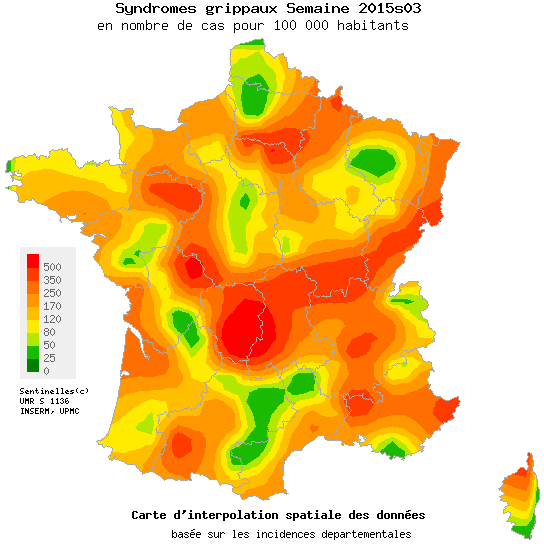
According to the weekly bulletin of the Sentinelles network, the incidence of influenza crossed the epidemic threshold last week, with 231 cases detected in general practice per 100,000 inhabitants. A figure that exceeds the epidemic threshold (179 cases per 100,000 inhabitants).

At regional level, the highest rates of incidence were found in: Limousin, Auvergne and Corsica.

According to researchers, the epidemic of influenza-like illness is set to increase in intensity this week, thus confirming the onset of the epidemic.

The GrippeNet.fr study presently has 5,416 participants registered on the www.grippenet.fr website. This research project, established by the Sentinelles network (Inserm – UPMC) and the French Institute for Public Health Surveillance, enables everyone to participate in influenza surveillance and research in metropolitan France, anonymously, voluntarily and directly online.

Additional data on influenza-like illness measured in the general population and the Sentinelles network’s Bulletin of 21/01/15 are available at Grippenet.fr

carte grippe 22012015

Suicide rate and increased unemployment

A study conducted by Inserm’s Centre for Epidemiology on Medical Causes of Death (CépiDc) and the Paris public hospital system (AP-HP) highlights an association between suicide rate and unemployment in metropolitan France between 2000 and 2010.

The statistical model actually reveals a mean 1.5% increase in suicide rate, both sexes combined, for a 10% increase in unemployment rate. This association is clearer in men aged 25-49 years, for whom the rise in unemployment has been accompanied by a 2.6% increase in suicide rate.

Published last Tuesday in Bulletin Épidémiologique Hebdomadaire (BEH), a weekly epidemiological bulletin published by InVS (French Institute for Public Health Surveillance), this work is based on suicide mortality data compiled by CépiDc in France between 2000 and 2010. The latter were cross-correlated with the corresponding unemployment rates for the quarter and region.

The researchers, however, make it clear that no cause and effect relationship can be deduced from these results, and recall the importance of individual circumstances (environmental factors, psychiatric profiles of individuals, etc.).

Gastroenteritis for holiday season

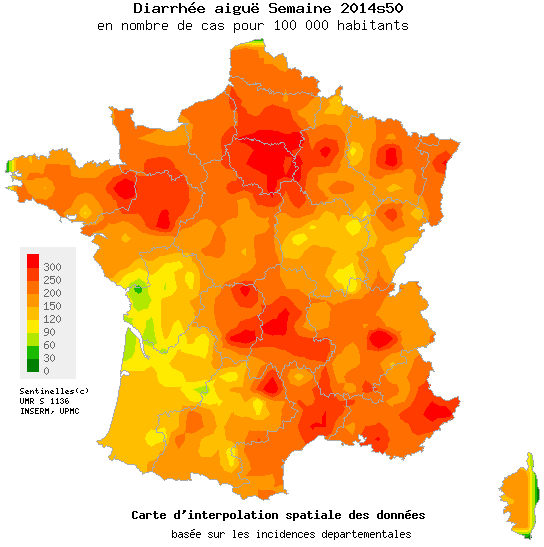
In metropolitan France last week, the incidence rate for cases of acute diarrhoea seen in general practice was estimated at 253 cases per 100,000 inhabitants, i.e. 160,000 new cases, higher than the previous week, and just below the epidemic threshold (269 cases per 100,000 inhabitants).

At regional level, the highest rates of incidence were found in Limousin, Provence-Alpes-Côte-d’Azur and Ile-de-France.

The Réseau Sentinelles (Sentinel Network): a collaboration between general practitioners and researchers

Since 1984, the French National Institute of Health and Medical Research (Inserm) and Pierre and Marie Curie University (University of Paris 6) have developed an information system based on a network of general practitioners in metropolitan France known as the Réseau Sentinelles (Sentinel Network). It has enabled the creation of large databases for several diseases, with descriptions of individual cases seen in general practice, for health surveillance and research purposes.
The Réseau Sentinelles is a network of 1,300 private general practitioners (i.e. 2.2% of all private GPs in metropolitan France), distributed throughout the French metropolitan territory, who contribute on a voluntary basis. Member physicians are known as “Sentinel physicians.”

For further information, visit the Réseau Sentinelles website

gastro

Bubble Babies: a new gene therapy

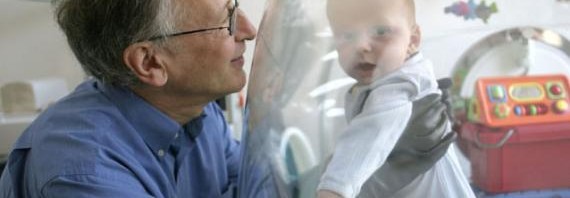
9 children with X-linked severe combined immunodeficiency have received a new form of gene therapy. Alain Fischer, Marina Cavazzana-Calvo and Salima Hacein-Bey-Abina, together with their teams at Inserm Unit 1163 and AP-HP, have just published these results in the New England Journal of Medicine.

In 1999, these researchers pioneered the treatment by gene therapy of children with a disease that left them without any immune defences. However, some of these children developed leukaemia after therapy. Following the development of safer therapeutic vectors, it was possible to start a new clinical trial in 2010.

4 years later, the results obtained and described in this scientific article are encouraging. 7 children treated using this method are now in good health.

For more information, see the press release “Les “bébés-bulle” ont 11 ans: L’efficacité de la thérapie génique est démontrée (“Bubble babies” are 11 years old: the efficacy of gene therapy is demonstrated),” published in July 2010

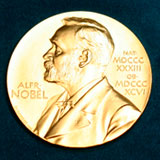
Nobel Prize in Chemistry 2014

The 2014 Nobel Prize in Chemistry was awarded to two Americans, Eric Betzig and William Moerner, and a German, Stefan Hell, on Wednesday 8 October “for the development of super-resolved fluorescence microscopy,” nanoscopy, as the jury said in its press release.

The laureates developed two methods enabling microscopy on a nanometric scale, and hence the study of living cells in the finest detail.

Stefan Hell, 51 years old, discovered “stimulated emission depletion (STED)” microscopy. Eric Betzig, 54 years old, and William Moerner, 61 years old, each working separately, created the method known as “single-molecule microscopy.”

Work useful in understanding, in particular, diseases such as Parkinson’s, Alzheimer’s and Huntington’s diseases.

Further information in the Nobel Prize official press release
See also the diagrams explaining STED microscopy, and single-molecule microscopy

Nobel Prize in medicine 2014

The Nobel Prize of physiology or medicine 2014 is awarded to John O’Keefe,  May-Britt and Edvard I. Moser for their work about for their discoveries of cells that constitute a positioning system in the brain.

May-Britt’s work, conducted with Edvard Moser as a long-term collaborator, includes the discovery of grid cells in the entorhinal cortex, as well as several additional space-representing cell types in the same circuit.

Read the press release

See the computer graphic

One third of caesareans could be avoided

For 40 years, the practice of caesarean section has become increasingly common all over the world. It is also associated with a higher risk of infectious complications for both the mother and child.

In an article published in the specialist journal ACTA, Benedicte Coulme and Beatrice Blondel, who are researchers at Inserm in Unit 1153: Epidemiology and Biostatistics, have reported the results of a study conducted on a sample of approximately 15,000 women over a period of four years.

Their objective was to classify the caesareans observed into two categories: those which could have been avoided and those which were considered to be inevitable.

According to the results obtained, 28% of the caesareans performed in France could have been avoided.

Chikungunya virus epidemic

The chikungunya virus is an infectious arboviral disease from the family Togaviridae. It comes from tropical regions and is transmitted by Aedes mosquitos. The virus is contracted by the mosquito when it bites an infected individual. It then becomes a carrier and can transmit the disease by biting a healthy person. There is no curative treatment for the virus, although INSERM researchers have discovered a human cellular factor involved in virus replication (source).

As of Friday 11th July, the chikungunya virus is now considered a major epidemic by the Ministry of Health. According to the French Institute for Public Health Surveillance, between 2,500 and 3,000 new cases are recorded in Martinique and approximately 5,000 cases in Guadeloupe on a weekly basis.

There is also a risk of infection in mainland France due to some 400,000 people returning from the West Indies who are living in France.

National Day of Screening for Skin Cancer

© Fotolia

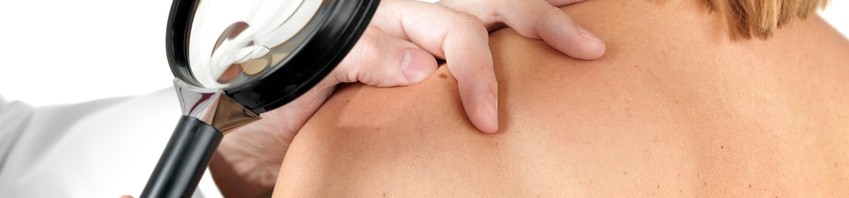
The 16th edition of the National Day of Screening for Skin Cancer will be held on Thursday, 22 May. It is organised by the French National Union of Dermatologists, with the support of the French National Cancer Institute (INCa). This day is an opportunity to recall the importance of prevention and monitoring in dermatology. The earlier cancer is detected, the lower the risks of spread, especially for melanoma.

Melanoma
Melanoma is a malignant tumour that develops in cells known as melanocytes, which are responsible for skin pigmentation. In 2012, there were an estimated 11,000 new cases of melanoma, and 1,672 deaths were recorded(1). Exposure to ultraviolet rays is the main cause of this cancer. However, there are recommendations for preventing it: avoid sun exposure between 12:00 noon and 4:00 pm, protect yourself by covering up and by using protective sun cream, and do not use tanning booths. See all our press news on melanoma
(1) Source: INCa

Caroline Robert
Leader of the “Melamona” group at Inserm Unit 981, “Identification of Molecular Predictors
and New Targets for Cancer Treatment;” Head of Dermatology Service at Gustave Roussy Institute
+33 1 42 11 42 10
rf.yssuorevatsug@TREBOR.eniloraC

Study of inflammatory skin diseases

At Inserm, the Immunodermatology team, as part of the Inserm Unit “Biotherapies of Genetic Diseases and Cancers” in Bordeaux, with support from the ATIP-AVENIR programme, aims to better understand the physiopathology of certain skin diseases such as inflammatory dermatoses like vitiligo, psoriasis, atopic dermatitis or systemic lupus erythematosus, by carrying out clinical or fundamental research based on these new concepts of cutaneous immunosurveillance.

Julien SENESCHAL
Dermatologist and Head of the Inserm Immunodermatology team (ATIP-AVENIR), Inserm Unit 1035, “Biotherapies of Genetic diseases and Cancers”
+33 5 57 57 13 74
rf.xuaedrob-uhc@lahcsenes.neiluj

fermer