In an article which appeared in The New England journal of Medicine on 16 April, researchers from Inserm (Jean Mérieux-Inserm BSL-4 Laboratory, Lyon) and the Institut Pasteur have published their initial findings on the characteristics of the Ebola virus discovered in Guinea. Initial virological investigations enabled them to identify Zaire ebolavirus as the pathogen responsible for this epidemic. Performed in less than a month, sequencing of the complete genome...
A team led by Ludwik Leibler from the Laboratoire Matière Molle et Chimie (CNRS/ESPCI Paris Tech) and Didier Letourneur from the Laboratoire Recherche Vasculaire Translationnelle (INSERM/Universités Paris Diderot and Paris 13), has just demonstrated that the principle of adhesion by aqueous solutions of nanoparticles can be used in vivo to repair soft-tissue organs and tissues.
A study, carried out on mice, has just confirmed the neurobiological origin of attention - deficit disorder (ADD), a syndrome whose causes are poorly understood.
Researchers at Inserm and University of Lille 2/University of Lille Nord de France directed by David Blum, Inserm Research Fellow, have provided experimental evidence of the beneficial effects of caffeine in an animal model of Alzheimer’s disease. This work, carried out on mice and published in Neurobiology of Aging, supports the idea that caffeine has a protective effect in some brain pathologies.
Scientists from INRA and INSERM (France) have shown that Elafin, a human protein, plays a key role against the inflammatory reaction typical of celiac disease (gluten intolerance).
The team led by Hélène Puccio, director of research for Inserm at the Institute of Genetics and Molecular and Cellular Biology (IGBMC) (Inserm / CNRS / University of Strasbourg) in close collaboration with Patrick Aubourg’s team (Inserm and Professor of Neuropaediatrics at Bicêtre Hospital) has demonstrated, in the mice, the efficacy of gene therapy for […]
The French National Institute of Health and Medical Research (Inserm) is currently the leading biomedical research organisation in Europe, and plays a key role in developing European research. To mark its 50th anniversary, Inserm wanted to assess the perceptions of Europeans regarding biomedical research.
Researchers have made a step forward in the understanding of how eating behaviours and preferences form in early life.
From analysis of data from the ELANCE cohort, Marie Françoise Rolland-Cachera, former researcher at Inserm and her co-workers in the Nutritional Epidemiology Research Team (EREN)[1] have shown that breast-feeding has a protective effect on the risk of obesity at 20 years of age.
Vincent Mallet, Stanislas Pol and their team at the Institut Cochin (Paris Descartes University, Assistance Publique – Hôpitaux de Paris, CNRS, Inserm) and French hospital-based teams* have proved the efficacy of a treatment for patients suffering from chronic hepatitis E virus infection.
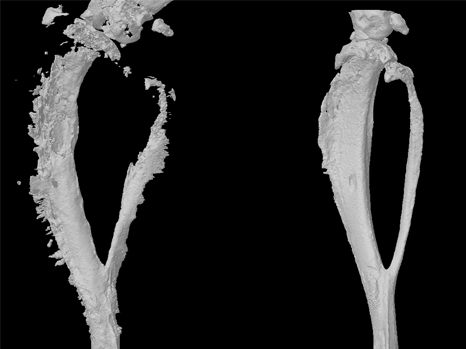
Researchers in Inserm Unit 957 "Bone Resorption Physiopathology and Primary Bone Tumour Therapy" in Nantes have recently developed an innovative treatment which stops the vicious circle that allows bone cancer to progress.