Menu

One Step Closer to Restoring Respiratory Function in Cystic Fibrosis?

© Fotolia

A new study by Olivier Tabary and his colleagues at the Saint-Antoine Research Center (Inserm Unit 938/Université Pierre et Marie Curie (UPMC), Sorbonne Universities) has revealed a new mechanism that makes it possible to restore the functioning of a cell channel found particularly in the lung mucosa of cystic fibrosis patients. This transfer, usually operated by the CFTR protein, is deficient in patients with cystic fibrosis and known for forming the basis of the disease. The findings, published in Nature Communications, open up the possibility of a therapy that would enable sufferers to recover their respiratory function.

Cystic fibrosis is a serious illness which affects digestive and pulmonary function, and affects 1 in every 4,500 newborns on average. Thanks to progress made by research, life expectancy has increased from a mere 5 years in 1960 to around 40, at present. This genetic disease is related to the deficiency of an extremely unstable gene, located on chromosome 7 which encodes a protein known as the cystic fibrosis transmembrane conductance regulator (CFTR). To date, over 2,000 mutations in this gene have been identified, making therapeutic approaches complicated.

Present in cell membranes of various mucous membranes (digestive system, lungs, etc.), the CFTR protein works as a channel transporting chloride ions into and out of cells. When the protein is deficient (following the mutation of the coding gene), the channel ceases to function. In the lungs, this brings about cycles of chronic infection and inflammation leading to the destruction of the pulmonary epithelium. The person will then present symptoms of cystic fibrosis.

Since the discovery in 1989 of the CFTR gene implicated in cystic fibrosis and the underlying genetic mechanisms, researchers have continued to further knowledge and propose new therapies. Nevertheless, these therapies have only been used in a small proportion of patients up until now, and with relatively weak effects. In 2008, the Anoctamin-1 (ANO1) chloride channel was identified for the first time. Given the deficiency of the CFTR protein in cystic fibrosis patients, the ANO1 channel was proposed as a therapeutic target for restoring chloride efflux.

 In a recent study published in Nature Communications and conducted by Olivier Tabary (Inserm Unit 938 Saint-Antoine Research Center), the researchers describe a regulation mechanism revealing the inhibitory effect of a microRNA (mirR-9) on the ANO1 channel.

With a therapeutic objective in mind, the team of researchers has succeeded in preventing miR9 from binding to ANO1 – thanks to the synthesis of a nucleic acid sequence. This makes it possible to stop microRNA inhibition of the chloride channel and restore its function.

 “Using this technique, we were able to restore chloride efflux, tissue distribution and mucociliary clearance in the cell lines of mice and cystic fibrosis patient cell cultures. These are all important parameters in the disease’s progression. Such a strategy would ultimately make it possible to target all patients with cystic fibrosis, regardless of their gene mutation, and correct major parameters in the development its pathophysiology,”  explains Tabary.

Further reading: Dossier d’information sur la mucoviscidose (in French)

A crucial enzyme finally revealed

© L. Peris /GIN

After 40 years of research, researchers at the CEA, the CNRS, the University of Grenoble-Alps, the University of Montpellier and the Inserm have finally identified the enzyme responsible for the tubulin cycle. Surprisingly, it is not one enzyme but two which control the cycle of this essential component of the cytoskeletal structure. This work opens up new prospects for the improved understanding of the role of tubulin, changes in the cycle of which are associated with cancers, cardiac diseases and neural disorders. These results were published on 16th November 2017 in the review Science.

A collaborative international project involving researchers from the CEA (French Atomic Energy Commission), the CNRS (National Centre for Scientific Research), the Inserm (French National Institute of Health and Medical Research), the University of Grenoble-Alps, the University of Montpellier and the University of Stanford[1] has identified an enzyme, Tubulin CarboxyPeptidase (TCP), which is responsible for the biochemical transformation of cellular microtubules, or detyrosination. Detyrosination is a biological reaction for the removal of the terminal amino acid tyrosine[2] from tubulin α, a constituent of microtubules. After four decades of research, biologists have succeeded in isolating this protein by purification, and have gone on to provide evidence of its cellular activity.

Microtubules contribute to essential cellular functions

Microtubules are dynamic fibres which are present in all cells. Formed by the combination of two proteins (tubulin α et tubulin β), microtubules assume numerous functions. They separate the chromosomes which are to be contained in the two daughter cells resulting from cell division, they contribute to the polarity of cells, morphology and cellular migration. They form “rails” upon which cellular constituents, such as proteins or RNA strands, are transported.

These cellular functions are regulated by the existence of “signals” which are present on the surface of microtubules. These signals are biochemical modifications to amino acids (described as post-translational modifications, as they take place after protein synthesis), executed by various enzymes which, in this case, modify the tubulins.

 The enzyme TCP, identified after 40 years of mystery

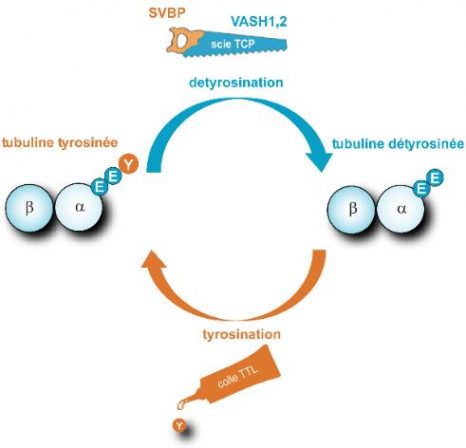
The activity of one of these enzymes was identified for the first time in 1977 by Argentine researchers, who named it “TCP” (Tubulin CarboxyPeptidase). The function of this enzyme, which had never been identified previously (its size and sequence were unknown) is the removal of the terminal amino acid, a tyrosine, from the end of tubulin α. This is the detyrosination reaction. A reverse enzyme, ligase TTL, is responsible for resetting this tyrosine in its place. This is tyrosination. This detyrosination/tyrosination cycle is vital for the cell and the organism. Massive (abnormal) detyrosination is observed in a number of severe cancers and cardiac diseases.

The identification and characteristic definition of TCP was therefore a major objective for understanding the physiological function of the detyrosination of tubulin α and evaluating the consequences of its inhibition.

In order to isolate TCP, researchers have monitored its activity, employing conventional biochemical techniques, and have involved chemists from the University of Stanford, who have developed a small inhibitor molecule for its activity. This molecule has been used as bait to “reel in” the desired enzyme.

Tubulin detyrosination/tyrosination cycle

Microtubules are fibres which are present in all cells, comprised of a stack of α/β tubulins. Tubulin carries a tyrosine (Y) at its end, which is alternately removed and replaced by two enzymes, thereby modifying the surface of microtubules. TCP (which is represented by a saw comprised of two elements, VASH/SVBP) is responsible for detyrosination. TTL (represented by a tube of glue) resets tyrosine on the tubulin. This cycle is essential to the various functions of microtubules in cells (division, migration, etc.) and is vital for the organism. © C. Bosc, GIN


SVBPSVBP
VASH1,2VASH1,2
scie TCPTCP saw
detyrosinationdetyrosination
tubuline tyrosinéetyrosinated tubulin
tubuline détyrosinéedetyrosinated tubulin
tyrosinationtyrosination
colle TTLTTL glue


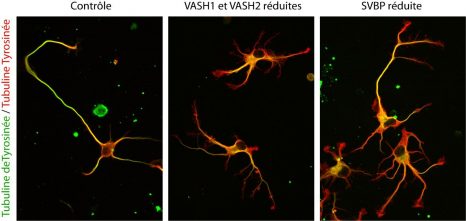
Ultimately, not one, but two enzymes have been discovered. The latter, named VASH1 and VASH2, were already known to scientists, but it was not known that these were enzymes associated with the cytoskeleton. Researchers have demonstrated that, provided they are associated with a partner protein called SVBP, VASH1 and VASH2 are capable of the detyrosination of tubulin α. To demonstrate this, researchers have inhibited the expression of the former (or that of their partner SVBP) in neurons. They then observed a very strong decline in the rate of detyrosination of tubulin α, together with anomalies in the morphology of neurons (see Figure). Researchers went further, demonstrating that these enzymes are also involved in the development of the cerebral cortex.

Prospects for the fight against cancer

Thus, forty years after the conduct of the first work on the detyrosination of tubulin α, the enzymes responsible have been revealed. Scientists are now hoping that, by modulating the effectiveness of TCP and improving their knowledge of the detyrosination/tyrosination cycle, they can advance the fight against certain cancers, and achieve progress in the understanding of cerebral and cardiac functions.

ContrôleControl
VASH1 et VASH2 réduitesVASH1 and VASH2 reduced
SVBP réduiteSVBP reduced
Tubuline deTyrosinée / Tubuline TyrosinéeDetyrosinated tubulin / Tyrosinated tubulin

Photographs of the alteration of neurons associated with a reduction in the expression of TCP enzymes (VASH/SVBP). From left to right: control neuron, neurons in which the expression of VASH1 and VASH2 is reduced, neurons in which the expression of SVBP is reduced. Neurons with a reduced enzyme show a delay in development, together with morphological anomalies.

[1] The following institutes are involved: Grenoble Institute of Neurosciences, GIN (Inserm/Univ. Grenoble-Alps); Institute of Biosciences and Biotechnologies of Grenoble, BIG (Inserm/CEA/Univ. Grenoble-Alps); Institute of Advanced Biosciences, IAB (Inserm/CNRS/Univ. Grenoble-Alps), Department of Pathology, Stanford University School of Medicine (Stanford, USA), Institute of Human Genetics, IGH (CNRS/Univ. of Montpellier), Montpellier Centre of Cell Biology Research, CRBM (CNRS/Univ. of Montpellier).

[2] Tyrosine is one of the 22 constituent amino acids in proteins.

December 1, 2017: World AIDS Day

Friday December 1, 2017, is World AIDS Day.

Introduced by the World Health Organization in 1988 and observed in many countries each year since, this day aims to inform and raise awareness of the prevention, treatment and management of human immunodeficiency virus (HIV)/AIDS.

AIDS is a scourge that affects the world’s poorest countries and populations most particularly. In 2015, 37 million people[1] were living with HIV.

Big Killers: AIDS

Actively involved in research relating to the virus, Inserm researchers are mobilized all year round to find new strategies for its prevention, diagnosis and treatment.

Earlier this year, France hosted the 9th IAS Conference on HIV Science biennial gathering of the International AIDS Society. Inserm was one of the partners involved.

To find out more about recent INSERM/ANRS news on this topic:

[1] Source: WHO

The consumption of antioxidant-rich foods is associated with a lower risk of type 2 diabetes

A lower risk of type 2 diabetes has been observed among individuals consuming food rich in antioxidants. This effect is largely contributed by fruit, vegetables, tea and other hot beverages, as well as moderate consumption of alcohol, as shown in a recent study from an Inserm research group, published in Diabetologia, the journal of the European Association for the Study of Diabetes (EASD)

A diet rich in fruit and vegetables has previously been associated with a lower risk of certain cancers and cardiovascular conditions. An Inserm team (Health across generations, Center of Research in Epidemiology and Population Health, Villejuif, France) has now shown that such a diet is similarly associated with a reduced risk of type 2 diabetes.

The team already suspected there might be a link on the basis of previous studies showing that certain antioxidants, such as vitamins C and E, lycophenes or flavonoids, were associated with a reduction in type 2 diabetes risk. However, these studies looked only at isolated nutrients, not at the total antioxidant capacity of the diet. The researchers therefore wanted to verify whether overall diet, according to its antioxidant capacity, is associated with diabetes risk. Using data from the E3N cohort comprising French women recruited from 1990, then aged between 40 and 65 years, they followed 64,223 women from 1993 to 2008, all of whom were free from diabetes and cardiovascular disease at the time of inclusion in the study. Each participant completed a dietary questionnaire at the beginning of the study, including detailed information on more than 200 different food items. Using this information, together with an Italian database providing the antioxidant capacity of a large number of different foods, the Inserm researchers calculated a score for ‘total dietary antioxidant capacity’ for each participant. The group then analysed the associations between this score and the risk of diabetes occurrence during the follow-up period.

The results show that diabetes risk diminished with increased antioxidant consumption up to a level of 15 mmol/day, above which the effect reached a plateau. Increasing dietary antioxidants to this level could be achieved through eating antioxidant-rich foods such as dark chocolate, tea, walnuts, prunes, blueberries, strawberries or hazelnuts, to name just a few.

Women with the highest antioxidant scores had a reduction in diabetes risk of 27% compared with those with the lowest scores. ‘This link persists after taking into account all the other principal diabetes risk factors: smoking, education level, hypertension, high cholesterol levels, family history of diabetes and, above all, BMI, the most important factor’, clarifies Francesca Romana Mancini, the first author of this study. The foods and drinks that contributed the most to a high dietary antioxidant score were fruits and vegetables, tea and red wine (consumed in moderate quantities). The authors excluded coffee from the analysis, despite its high antioxidant levels, because the antioxidants in coffee have already been shown to be associated with reduced type 2 diabetes risk, and might therefore mask the effects of antioxidants from other sources.

‘This work complements our current knowledge of the effect of isolated foods and nutrients, and provides a more comprehensive view of the relationship between food and type 2 diabetes’ explains Guy Fagherazzi, the lead researcher in charge of diabetes research in the E3N study. ‘We have shown that an increased intake of antioxidants can contribute to a reduction in diabetes risk’. This now raises the question why: ‘We know that these molecules counterbalance the effect of free radicals, which are damaging to cells, but there are likely to be more specific actions in addition to this, for example an effect on the sensitivity of cells to insulin. This will need to be confirmed in future studies’, concludes Francesca Romana Mancini.

The E3N study (e3n.fr; Etude Epidémiologique auprès de femmes de la MGEN [Mutuelle Générale de l’Education Nationale]) is a prospective cohort study of around 100,000 French female volunteers born between 1925 and 1950, and followed from 1990. Since 1990, the women have completed and returned self-administered questionnaires every 2–3 years. The questionnaires cover their lifestyle and their  health status over time. The ‘lost to follow-up’ rate is very low because the MGEN is able to assist in following up non-responders.  The E3N study is supported by four founding partners: Inserm, la Ligue contre le Cancer, l’Institut Gustave Roussy and the MGEN. The E3N study is now continued via the E4N study (e4n.fr), a study awarded the status of  ‘Investment for the future’ (Investissement d’Avenir) in 2011 by the French National Research Agency (Agence Nationale de Recherche), and which aims to follow the children and grandchildren of the E3N participants, as well as the biological fathers of the children, with a view to studying the health of three generations of family members in relation to modern lifestyle.

Efficacy of online nutritional coaching in patients with type 2 diabetes and abdominal obesity

©Fotolia

A study coordinated by Dr. Boris Hansel and Prof. Ronan Roussel, from the Diabetes-Endocrinology and Nutrition Department at Hôpital Bichat – Claude-Bernard, AP-HP and the Cordeliers Research Center (Inserm/Pierre and Marie Curie University, Paris Diderot, Paris Descartes University) shows that online nutritional coaching -an automated nutritional support program- improves dietary habits and glycemic control in patients with type 2 diabetes and abdominal obesity.

These results were published in the Journal of Medical Internet Research, JMIR on November 8, 2017.


Several nutritional coaching offers (personal support) have appeared on the internet in recent years, particularly in France. Whether a passing craze or a genuine revolution in nutritional management methods, online coaching is emerging as part of the treatment of chronic disorders. It is now being tested in certain hospitals, such as Hôpital Bichat-Claude Bernard, AP-HP, in order to achieve online support practically comparable to face-to-face contact.

Eating a balanced diet and taking appropriate regular physical exercise are the basis for treating type 2 diabetes and excess weight. However, for many diabetics, these recommendations are difficult to apply in the long term due to the lack of specific guidance in determining where efforts should be focused. While online support tools have been shown, in certain cases, to be effective, no French studies have tested online nutritional coaching to date, particularly for diabetes and/or abdominal obesity, in terms of reducing calorie intake and increasing physical exercise, resulting in weight loss similar to that achieved through hospital follow-up.

The research team tested a fully automated online coaching tool: the “Accompagnement Nutritionnel de l’Obésité et du Diabète par E-coaching – ANODE” [Diabetes and Obesity Nutritional Support Coaching] program developed by MXS. This program combines an electronic nutritional assessment and patient support in terms of diet and physical exercise. The researchers analyzed the utility of this program in patients with type 2 diabetes in a bicenter randomized trial.

The ANODE study was opened to 120 male or female volunteers, aged 18 to 75 years, with type 2 diabetes and overweight, particularly in the abdominal area, and having internet access.

Two groups were created: an investigational group benefiting from the ANODE automated online coaching program, and a control group receiving standard nutrition advice over a four month period.

The researchers monitored the changes in a diet quality score out of 100 (Diet Quality Index-International, calculated with a dietary diary over 3 days) between Study 1 (D-20 to D-2) and Study 2 (D100 to D118). At the same time, they measured the changes in “HbA1c or glycosylated hemoglobin”, i.e., hemoglobin which is chemically bound to glucose, cardiovascular risk factors, and physical aptitude (direct measurement of VO2max).

The two groups were comparable at baseline: 67% of females aged 57 years, with a BMI of 33 and diet index of 53.4/100 on average.

The results show that the diet index increased significantly in the online coaching group (+5.25 points) relative to the control group (-1.83) on average. The changes in food intake were more favorable in this group, with a reduction in fat, saturated fat, sodium and “empty calories” (calories provided by low-nutrient-dense foods).

Patient weight, waist measurement, and HbA1c also showed a more favorable reduction with this program. At least 5% weight loss is observed in 26% and 4% of subjects in the online coaching and control groups, respectively. The changes in plasma lipids and blood pressure are similar between the groups, and VO2max showed an identical increase in the two groups.

In conclusion, the online coaching program improved nutritional habits and glycemic control in patients with type 2 diabetes, in 16 weeks. It achieved its objective by significantly reducing weight and waist measurement. This program, which is adapted to patients, also has the advantage of being inexpensive as it is fully automated. These results thus encourage the development of online nutritional coaching in the follow-up of patients with type 2 diabetes.

The team is expected to initiate a national study on a larger scale next spring, over a one-year period, with an optimized connected health program. From January 2018, the AP-HP/Paris-Diderot University research team will be offering training in connected health, as part of the university diploma “Multidisciplinary practical training in connected health”.

World Diabetes Day

©Fotolia

Celebrated every November 14 since its creation in 1991, World Diabetes Day is an opportunity to raise collective awareness of the condition and, above all, the resources deployed to manage it. Diabetes refers to consistently higher than normal blood sugar levels (hyperglycemia).  Two types of diabetes can be distinguished:

– Type 1, an auto-immune disease characterized by the insufficient production of insulin;

– Type 2, which occurs as the result of the poor use of insulin by the body.

Over half of deaths attributable to hyperglycemia occur before the age of 70. The World Health Organization (WHO) predicts that, in 2030, diabetes will be the 7th leading cause of death worldwide. Source: WHO

Last year, we showcased the research of Eric Renard, head of Inserm Unit 1191 “Determinants and correction of insulin secretion loss in diabetes”, which was working on the development of an artificial pancreas usable in daily life by people with type 1 diabetes.

Read last year’s C dans l’air (in French)

In late 2016, early 2017, studies performed in some thirty patients, along with three from Montpellier, demonstrated the feasibility of a 6-month trial. In addition, the opportunity to use new devices, particularly in Europe, is arising. One such device is an implantable continuous glucose monitoring system, which could be used for up to 6 months, and would replace the current system that requires changing every 7 to 10 days. This ongoing integration work will be consolidated in the first quarter of 2018, and concern three European centers: Montpellier, Padua and Amsterdam. Around 24 patients will be enrolled at each center in order to participate in this study funded by the NIH.

Probiotic Bacteria Produces Potent Analgesic

©Fotolia

The intestinal microbiota still has surprises in store. The mode of action of a probiotic bacteria used in the symptomatic treatment of pain in irritable bowel syndrome has been revealed in a new study conducted by scientists from Inserm, Université de Toulouse and CHU de Toulouse [1] within the Digestive Health Research Institute (Inserm/INRA/Université Toulouse III – Paul Sabatier, ENVT). The bacteria produces a neurotransmitter (GABA) which, when bound to a lipid, crosses the intestinal barrier, acts on the sensory neurons located in the stomach, and reduces visceral pain. This new class of molecule, combining lipoprotein and GABA, could be used as a painkiller.

This research was published in Nature Communication.


Irritable bowel syndrome is a chronic disease characterized by abdominal pain associated with functional bowel disorders. This is a highly incapacitating disease which drastically reduces patient quality of life. Patients are powerless when faced with this syndrome, as no truly effective treatment exists for this disorder which affects 5% of the French population.

The probiotic bacteria Escherichia coli Nissle 1917[2], discovered during the First World War, was recently used as an orally administered alternative therapy for irritable bowel syndrome. Treatment with probiotics has become a popular trend given the “natural” characteristics of these products, and their supposed lack of toxicity. It is nonetheless essential to understand the molecular bases of their therapeutic properties. Research in this field examines and questions the origin of the bacterial factors behind these probiotic activities, and the validity of their use.

The scientists developed a project aiming to characterize the probiotic activity of the E. coli Nissle 1917 strain from this perspective. Their research shows that this bacteria produces GABA (gamma-aminobutyric acid) bound to an amino acid and a fatty acid. Together, these three molecules form a lipopeptide. GABA, the main nervous system inhibitory neurotransmitter, is then able to cross the intestinal barrier after the bacteria has bound it to this fatty acid. It can then bind to its receptor in order to diminish the activation of sensory neurons, and thus reduce pain. However, GABA cannot cross the intestinal barrier on its own (without its fatty acid).

Once the lipopeptide was identified and characterized, initial studies were first conducted on cultured murine sensory neurons. Exposing these neurons to capsaicin (the active substance of chili peppers) increased calcium flow, which is characteristic of the neurons’ hypersensitivity, compared to the control neurons. These changes in calcium flow are not observed in these neurons when they are pretreated by adding synthetic lipopeptide to the culture medium.

These studies were then conducted on mice. Electrodes placed on the animals were able to measure the intensity of abdominal contractions characteristic of pain (equivalent to stomach cramps in man). Once they ingested the synthetic lipopeptide, the abdominal contractions in the hypersensitive mice then became equivalent to those observed in the control mice.

This study has made it possible to file a patent for a new class of molecules that can be used as analgesics. “As these do not modify intestinal motility or physiology, we also hope that they will generate fewer side effects than morphine, for example. This should evidently be validated by future therapeutic trials,” states Nicolas Cenac.

This discovery demonstrates the importance of having a better understanding of the modes of action of the probiotics currently in use, and the therapeutic potential of lipopeptides produced by the intestinal microbiota.

Inserm Transfert has filed a patent application for this research.


[1] A team of physiopathologists and a team of bacteriologists from the Toulouse Digestive Health Research Institute (IRSD) (Inserm/INRA/Université Toulouse III – Paul Sabatier, ENVT) and teams of chemists from the Institute of Biomolecules Max Mousseron in Montpelier and the Metatoul network in Toulouse


[2] Named after the German physician Alfred Nissle who isolated this strain from a stool sample obtained from a soldier in the First World War, who was the only member of his unit that did not get dysentery.

Antibiotics affect the efficacy of immunotherapy


A study published in the journal Science by a research team from Gustave Roussy, INSERM, INRA, AP-HP, IHU Médiaterranée Infections* and Paris-Sud University shows that prescribed antibiotics impair the efficacy of immunotherapy in cancer patients. It is important to consider that more than 20% of patients living with cancer receive antibiotics. The authors explored patients’ gut microbiota composition by metagenomic analysis and demonstrated that the bacterium Akkermansia muciniphila was associated with a better clinical response to anti-PD-1 antibody immunotherapy. Moreover, oral administration of this bacterium to mice with an unfavorable microbiota restored the anti-tumor activity of the immunotherapy.

This paper will be published online by the journal Science on Thursday, 2 November 2017.

Immunotherapy represents a real revolution in cancer therapies and has been shown to be superior to standard chemotherapy in advanced melanoma, lung, renal and bladder cancer. Although a large proportion of patients still do not benefit from this treatment, “Our research partially explains why some patients do not respond. Taking antibiotics has a deleterious impact on survival in patients receiving immunotherapy. Furthermore, the composition of the intestinal microbiota is a new predictive factor for success,” summarized Dr. Bertrand Routy, hematologist and member of the team of Professor Laurence Zitvogel, director of the “Immunology of tumors and immunotherapy” laboratory (Inserm/Paris-Sud University/Gustave Roussy).

In a cohort of 249 patients treated with anti-PD-1/PD-L1 based immunotherapy for advanced lung, kidney or bladder cancer, 28% received antibiotics for minor infections (dental, urinary or lung infections) but their general health status was not different from patients not receiving antibiotics.

The study’s findings revealed that taking antibiotics two months before and up to one month after the first treatment had a negative effect on progression-free survival and/or overall survival for these three types of cancer.   

Favorable microbiota determined by metagenomics

The precise composition of the gut microbiota was established by metagenomics both before and during immunotherapy in 153 patients with advanced lung or kidney cancer. The  identification of all the bacterial genes present in the gut microbiota was performed by INRA (MetaGenoPolis, Dr. Emmanuelle Le Chatelier). A favorable microbiota composition, rich in Akkermansia muciniphila, was found in patients with the best clinical response to immunotherapy and in those whose disease had not progressed for at least 3 months.

Improving unfavorable microbiota

To demonstrate a direct cause and effect relationship between the composition of gut microbiota and the efficacy of immunotherapy, favorable microbiota (taken from patients who had a good response to PD-1 immunotherapy) and unfavorable microbiota (from patients with therapeutic failure) were transferred to mice deprived of gut microbiota. The mice receiving the favorable microbiota did better when treated with immunotherapy than those who received the unfavorable microbiota. In the latter group, oral administration of Akkermansia muciniphila resulted in the restoration of the efficacy of anti-PD-1 immunotherapy. Changing the microbiota in the mouse re-established the effectiveness of immunotherapy by activating certain immune cells.

Results simultaneously reported in the same edition of the journal by an american team (Dr. Jennifer Wargo, MD Anderson, Texas) support these findings showing that the composition of microbiota in melanoma patients predicts the response to anti-PD-1 immunotherapy.

This research is being carried out within the framework of the Torino-Lumière project (a 9 M€ “investissement d’avenir” [investment for the future] program). The objective of this unique study is to develop microbiome-based biomarkers that predict the response to immunotherapy in patients with lung cancer. This prospective multicenter study initiated in 2016 aims at determining unfavorable bacterial signatures to compensate patients with a combination of bacteria endowed with immunotherapeutic properties.

About immunotherapy

Immunotherapy has changed the way we treat various cancers. These novel immunotherapies include monoclonal antibodies (anti-CTLA4 or anti-PD1), transferring activated T-lymphocytes and bispecific agents, all boosting patient’s immune system.  They not only reduce tumor size but also, and for the first time, significantly increase patient overall survival, eventually curing metastatic or locally advanced cancers in melanoma.

About gut microbiota

Gut microbiota (previously known as intestinal flora) represents a complex ecosystem consisting of 100,000 billion bacteria, viruses, archaea, parasites and yeasts. They colonize the bowel from birth and participate in the maturation of immune defense mechanisms. Individuals have their own specific microbiota. Its composition is a product of genetic, nutritional and environmental factors.


* Gustave Roussy = Leading comprehensive cancer center in Europe

INSERM = National Institute for Health and Medical Research

INRA = National Institute for Agronomic Research

AP-HP = Paris Public Hospitals

New forms of expression of the variant of Creutzfeldt-Jakob disease observed within the scope of experimental transmissions

A team of French researchers from the CEA, AP-HP, CNRS, Inserm, Inra, ENVT, Institut Pasteur and MacoPharma have demonstrated that multiple variants of prions can coexist and manifest themselves in different clinical forms depending on the conditions of transmission. The results of this study are published in Nature Communications, dated 2 November 2017.

Fewer than 250 cases of variant Creutzfeldt-Jakob disease (vCJD) have been identified in the world, mainly in the United Kingdom, following the exposure of human populations to Bovine Spongiform Encephalopathy (BSE, or ‘mad cow disease’). However, over 99% of the human infections by these prions of bovine origin could remain silent according to British studies carried out on samples of appendices, which suggests a risk of inter-human transmission linked to such apparently healthy carriers, in particular through blood transfusions.

Assessment of the transfusional risk

Within the scope of the assessment of the transfusional risk linked to vCJD, researchers from the CEA, La Pitié-Salpêtrière university hospital, AP-HP, CNRS, Inserm, Inra, ENVT, Institut Pasteur and MacoPharma[1] exposed mice and macaques to blood products from vCJD-infected donors.

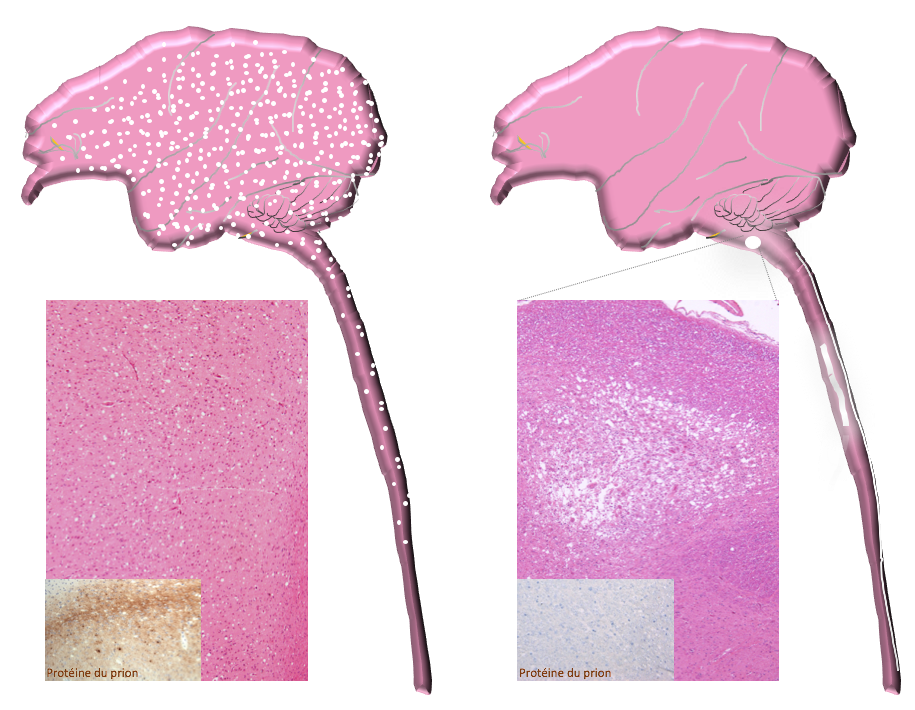
Through techniques traditionally used for the diagnosis of prion diseases (histology, biochemistry), the researchers found few cases of transmission of vCJD in its classic form (less than 3% of the animals exposed). These cases were mainly observed when the donors were strongly infected, which corresponds to the situation observed in humans[2].

Observation of myelopathies

On the other hand Emmanuel Comoy, CEA researcher and principal author, specifies, “in a significantly higher proportion (two to five times more according to the models studied, i.e. almost 10% of the animals exposed), some recipient animals developed fatal neurological syndromes different from vCJD”.

These syndromes do not present all of the classic characteristics of prion diseases (vacuole formation in the brain and accumulation of an abnormal form of the prion protein[3] resistant to deterioration by enzymes). They are referred to as myelopathies in affected primates because they are mainly centred on the spinal cord. These syndromes show themselves to belong to prion diseases, since their retransmission to the mice leads to the appearance of the classic characteristics of prion diseases.

Infection by healthy carriers

The myelopathic form of the disease was observed in animals transfused with blood from apparently healthy donors, i.e. donors exposed to prions and without an identifiable pathology, as well as from blood from patients presenting the clinical signs of vCJD.

The study thereby reveals a diversity of syndromes, from the healthy carriers to the typical form of vCJD: multiple variants of prions could therefore coexist and emerge under different clinical forms depending on the conditions of transmission (route of exposure, dose, nature of the contaminating product, aggregated or dispersed state of the prions).

In a context where human exposure through food intake to the BSE agent could have resulted in the emergence of numerous, apparently healthy, carriers, the researchers note that their study – which challenges the unicity of the vCJD/BSE origin – underlines the difficulty in detecting and preventing the transmission of all forms of prion infections. These questions are currently the subject of additiona.

Comparison of the lesions observed: The macaques developing a vCJD present a vacuolation and an accumulation of the abnormal prion protein in the entire nervous system (figure on left), whereas the lesions in the myelopathic macaques are concentrated in the lower cervical spinal cord and the brain stem, with no accumulation of abnormal prion protein detectable using classic techniques (figure on right). © CEA/E. Comoy.


[1] Institut François Jacob (CEA), Brain and spinal cord institute (CNRS/Inserm/UPMC/La Pitié-Salpêtrière university hospital, AP-HP), Neuromyogenics institute (CNRS/Inserm/Univ. Cl. Bernard Lyon 1/Lyon Civil Hospices), Host-pathogen Interactions laboratory (Inra/ENVT), Macopharma, Biology of Infections unit (Institut Pasteur), laboratory of Neurodegenerative diseases: mechanisms, therapies, imaging (CNRS/CEA/Univ. Paris Sud).

[2] Over the last ten years, four cases of contamination by the vCJD agent in the United Kingdom have been attributed to the transfusion of non-deleukocyted blood products (so-called ‘whole’ blood, whose white cells have not been removed) coming from donors who themselves developed a vCJD shortly after their blood donation. At present, blood products are systematically deleukocyted.

[3] A pathological prion is a pathogenic agent made up of a protein whose conformation or withdrawal is abnormal and which, unlike infectious agents such as viruses or bacteria, or even parasites, has no nucleic acid (DNA or RNA) as a medium for infectious information.

29 october 2017: world stroke day

A Cerebrovascular Accident results from the interruption of blood flow to the brain. The deprivation of oxygen and essential nutrients causes brain cells to die, leading to permanent damage (speech or writing difficulty, memory problems, bodily paralysis to a greater or lesser extent), or even sudden death.

World Cerebrovascular Accident Day is organised on 29 October each year and helps raise public awareness regarding the importance of immediate care for victims from onset of initial symptoms (confusion, speech problems, trouble understanding, dizziness, etc.).

Consult our last news about this topic :

Interaction between brain and heart may be new indicator of state of consciousness

©Fotolia

How do we know whether a patient is conscious when he or she is unable to communicate? According to an Inserm study conducted in 127 patients aged 17 to 80, changes in heartbeat in response to sound stimulation is a good indicator of state of consciousness. This is what Inserm researcher Jacobo Sitt and his team, based at the Brain & Spine Institute (ICM) at Pitié-Salpêtrière Hospital, AP-HP, demonstrate in an article published in Annals of neurology. This easy-to-perform examination complements the existing tests and enables finer predictive diagnosis, useful for both doctors and the patient’s loved ones.

The study of consciousness disorders distinguishes the vegetative state, in which the patient is awake but not conscious, from the minimal state of consciousness, which involves a certain degree of consciousness. Distinguishing between these states is very important in order to establish a prognosis on the patient’s neurological outcome, inform the patient’s loved ones, and implement suitable treatment. The tools developed up until now to determine state of consciousness, such as the electroencephalogram (EEG), functional MRI or PET scan, all concentrate on the brain. These methods require either heavy equipment or complex analysis.

Researchers from Inserm have used a novel approach, which consists of exploring the interaction between the heart and the brain.

Previous studies revealed that the “unconscious” processes of the autonomic nervous system, such as breathing or heartbeat, could be modulated by conscious cognitive processes. The perception of external stimulation, auditory stimuli, for example, could therefore be expressed by an effect on cardiac activity, and all the more easily if the subject is conscious.

By studying the data of 127 patients in vegetative or minimally conscious states, researchers observed that cardiac cycles were indeed modulated by auditory stimulation only in conscious or minimally conscious patients. They also showed that these results complemented those obtained with an EEG. Combining these tests (cardiac and EEG) markedly improves performance when predicting a patient’s state of consciousness.

These findings open up new perspectives for an overall approach in evaluating patient state of consciousness. The researchers now wish to extend the scope to include other physiological signals modulated by conscious processes, such as breathing or pupil dilation, in order to develop a comprehensive tool for better bedside evaluation of patient state of consciousness.

What does the auditory test involve?

The test involves playing sound sequences to the patient, which are repetitive to begin with and then, at random and infrequent intervals, present variations. During these variations, the researchers are able to determine whether there is a change in heartbeat, which would mean that the patient is aware of ambient sounds.

fermer