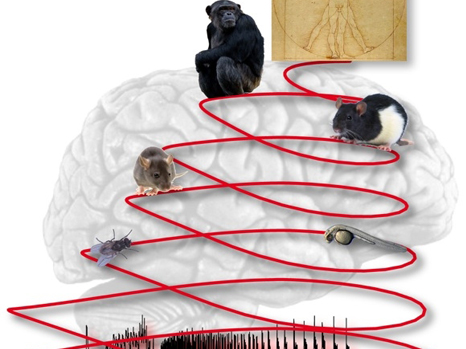
Tout semble différencier une mouche d'un homme. Et pourtant, aussi étonnant que cela puisse paraitre, des chercheurs de l'Inserm dirigés par Christophe Bernard et Viktor Jirsa au sein de l’Institut de Neurosciences des Systèmes (INS) – Inserm U1106 à Marseille viennent de montrer que les crises d'épilepsie suivent des règles mathématiques simples et conservées à travers les espèces. La crise d’épilepsie est une forme d’activité neuronale qui est encodée...
L’Institut national du cancer (INCa) et l’Inserm présentent, lors d’un colloque de restitution le 10 juin, les résultats d’une enquête de grande envergure interrogeant 4349 personnes atteintes d’un cancer deux ans après le diagnostic. Appelée VICAN2 pour « Vie après le Cancer à deux ans du diagnostic », cette enquête menée en 2012 constitue l’unique travail national qui rend compte des conditions de vie des personnes atteintes de cancer.
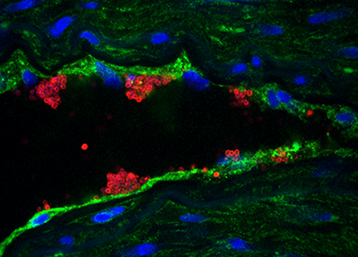
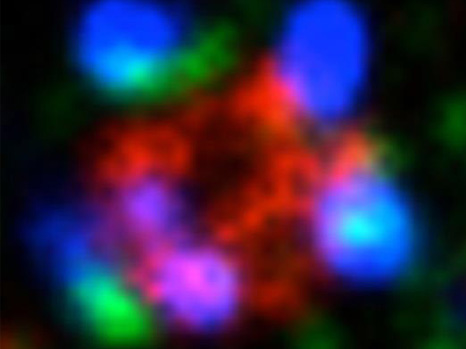
Neisseria meningitidis, also called meningococcus, is a bacterium responsible for meningitis and septicemia[1]. Its most serious form, purpura fulminans, is often fatal. This bacterium, which is naturally present in humans in the nasopharynx, is pathogenic if it reaches the blood stream. Teams led by Dr. Sandrine Bourdoulous, CNRS senior researcher at the Institut Cochin (CNRS/Inserm/Université Paris Descartes), and Professor Xavier Nassif, Institut Necker Enfants Malades (CNRS/INSERM/Université Paris Descartes/Assistance Publique...
A team of scientists led by Etienne Koechlin, Director of the Cognitive Neuroscience Laboratory (Inserm/ENS), has just decoded the reasoning process behind the human ability to adapt.
Throughout the school year, 33 junior and senior secondary school students have been hosted each month in 9 neuroscience laboratories specialising in addiction studies. The aim: to change the views of the young “Novice Researchers” of the hidden face of drugs (alcohol, tobacco, cannabis, etc.) and addiction, and to facilitate contact between young people and the world of research. From 27 May next, the Novice Researchers will present their...
The experts' analysis of data from recent international scientific literature was used to evaluate nutritional disparities based on individuals' socio-economic standing. The social, cultural, economic and environmental factors involved in creating social inequalities in nutrition were analysed.
By analysing the Fecond survey, conducted by Inserm and the French National Institute for Demographic Studies (INED) several months later, Nathalie Bajos, Mylène Rouzaud-Cornabas, Henri Panjo, Aline Bohet and Caroline Moreau examined the recent trends in contraceptive practices, and the contribution of media debate to these changes.
French researchers from Inserm Unit 1061, “Neuropsychiatry: Epidemiological and Clinical Research,” and their American colleagues at Harvard have just shown that retired people continued to be affected by their work with solvents in cases of high exposure.
A team from the Institut de biologie at the Ecole normale supérieure (CNRS/ENS/INSERM)(2) has described how in Paramecia, mating types are transmitted from generation to generation through an unexpected mechanism.
Carine Rossé, INSERM research fellow and Philippe Chavrier, Research Director at CNRS, working alongside Dr. Anne Vincent-Salomon, medical researcher at the Institut Curie, have recently discovered one of the mechanisms that allow triple negative breast cancer cells to exit the mammary gland.
Adrenocortical carcinoma (also known as adrenal cortex cancer or ACC), is a generally aggressive tumour, with a mean survival rate of less than five years for those affected. Apart from metastasis, it exposes the patients to manifestations such as high blood pressure, diabetes, decreased potassium level, infections, etc. There is, however, some patient-dependent variation in tumour development. The team led by Prof. Bertherat at the Cochin Institute (Inserm –...