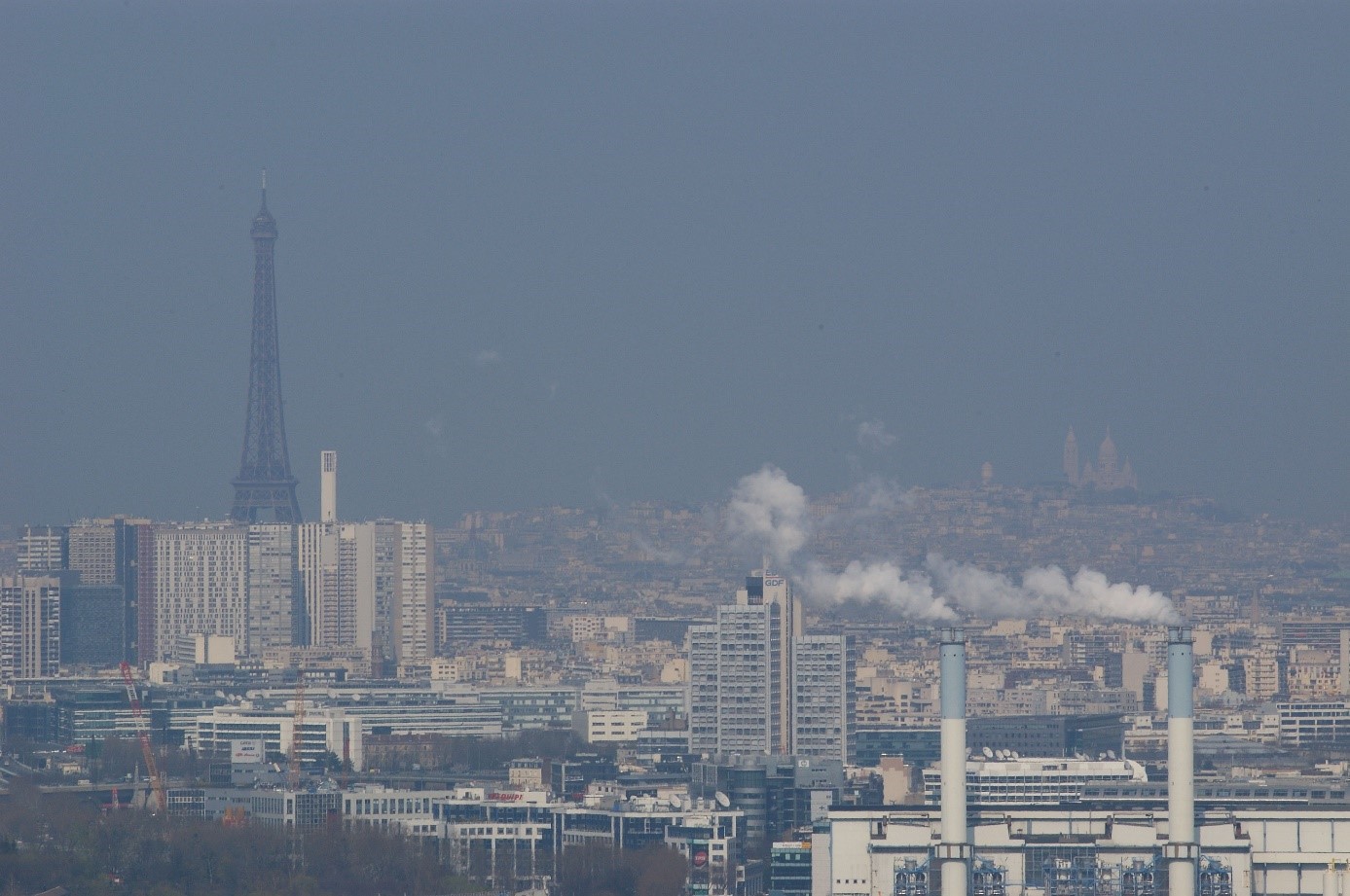
 Air pollution is an acknowledged environmental factor in high blood pressure. © Adobe Stock
Air pollution is an acknowledged environmental factor in high blood pressure. It consists of a mixture of particles and gases whose combined effects on human health are not yet well known. A team from Inserm and Sorbonne Université, assisted by international collaborators, used continuous monitoring to study the daily life impact of a mixture of five air pollutants on the blood pressure of 221 MobiliSense[1] study participants in the Greater Paris area. With two models – one taking into account variations in ambient air pollutant levels, the other variations in the amounts inhaled – the researchers observed an association with acute repeated blood pressure increases. This study, published in Environmental Research, paves the way for a better understanding of the link between air pollution and hypertension.
Hypertension is a chronic disease that affects one in three adults. Linked to abnormally high pressure of the blood in the blood vessels, it can lead to cardiovascular, cerebrovascular, and even neurodegenerative complications.
Previous studies have shown that some air pollution molecules affect blood pressure and could therefore promote hypertension. However, in everyday life, the air pollution to which people are exposed generally consists of mixtures of air pollutants rather than a single component in isolation – mixtures that had been little researched until now.
An international team led by Basile Chaix, Inserm Research Director at the Pierre Louis Institute of Epidemiology and Public Health (Inserm/Sorbonne Université), wanted to characterize the effects on blood pressure of the daily-life exposure to a mixture of five air pollutants – black carbon, nitrogen dioxide (NO2), nitrogen oxide (NO), carbon monoxide (CO), and ozone (O3) – in 221 participants from the MobiliSense study.
In order to study the effects of this complex mixture, the research team developed new monitoring methods and used innovative measuring equipment. Each participant wore an ambulatory blood pressure measurement device[2], two portable sensors to continuously measure pollutants in the ambient air near the breathing zone, a GPS tracker to record mobility, and an accelerometer to measure physical activity and thus estimate the ventilation rate[3] (the volume of air inhaled or exhaled per unit of time). The measurements were taken over one day in the lives of the participants.
Their blood pressure was measured every 30 minutes in order to observe as closely as possible the time between variations in ambient air pollutant levels, the estimated amount of pollutants inhaled, and their potential impact on blood pressure.
Learn more about blood pressure and hypertension
Blood pressure results from the ejection of blood from the heart into the blood vessels and consists of the pressure it exerts on the vessel walls. It is characterized by two values:
- the upper value or systole (systolic blood pressure), measured when the heart contracts. This pumps blood through the aorta to the peripheral arteries;
- the lower value or diastole (diastolic blood pressure), measured when the heart relaxes. This enables the cardiac ventricles to receive the blood that enters the atria through the vena cava- and pulmonary veins.
Hypertension is when the resting systolic value is above 140 mmHg and/or the resting diastolic value is above 90 mmHg.
The researchers observed that when the levels of all the pollutants in the mixture increased within the 5 minutes prior to measuring blood pressure, there was an increase in systolic pressure (see box). A similar association was also found between an increase in the amount of pollutants inhaled within the 5 minutes prior to measuring blood pressure (related to an increase in the concentrations measured and/or physical activity and therefore in the ventilation rate) and an increase in systolic pressure.
“We chose to consider short windows of exposure (5 min, 15 min, 30 min, 1 hour) to study the time between exposure to pollution and blood pressure response, specifies Chaix. Here we see that the association is weaker when the exposure is observed over windows longer than 5 minutes, which indicates the immediacy of the blood pressure elevation in response to increased levels of air pollutants in the studied mixture,” adds the researcher. He continues: “These repeated increases in blood pressure linked to exposure to air pollutants in urban areas when out and about could contribute to a chronic rise in blood pressure, month after month, year after year. “
Another observation from these two models is that – when we consider the individual contribution of each pollutant to the effect of the mixture on blood pressure – ozone and black carbon present as being the greatest contributors to its increase.
With few existing studies having used these measurement and modeling methods to study mixtures rather than isolated pollutants, the research team clarifies that it does not currently have the possibility to compare its findings with other research, which means that they should be interpreted with caution.
However, should these findings be confirmed, it may be possible to extrapolate them to the populations of other major European cities whose pollution levels are similar to those of Greater Paris.
As for the implications of the study, Chaix concludes: “Our findings call for air pollution to be considered as a cause of hypertension and for the rollout of public policies aimed at reducing exposure to this pollution in everyday life – and particularly that of road traffic in the heart of our towns and cities. “
Next on the agenda is for the team to explore the physiological mechanisms and causes behind the associations observed in this study.
[1]The MobiliSense study is conducted on inhabitants of the Greater Paris area and aims to explore the effects of air and noise pollution exposure on cardiovascular and respiratory health.
[2]Unlike the blood pressure measurements taken when the individual is in a resting state, ambulatory blood pressure measurements are taken throughout the day and during the course of the individual’s activities using a wearable device.
[3]In previous studies, the team had shown that the amount of polluted air inhaled was not directly proportional to the levels of pollutants in the breathing zone but was also dependent on the ventilation rate, which varies with the intensity of physical activity. The ventilation rate was therefore estimated for each participant based on the accelerometer measurements.