Menu

The surprising ability of blood stem cells to respond to emergencies

A research team of Inserm, CNRS and MDC lead by Michael Sieweke of the Centre d’Immunologie de Marseille Luminy (CNRS, INSERM, Aix Marseille Université) and Max Delbrück Centre for Molecular Medicine, Berlin-Buch, today revealed an unexpected role for hematopoietic stem cells: they do not merely ensure the continuous renewal of our blood cells; in emergencies they are capable of producing white blood cells “on demand” that help the body deal with inflammation or infection. This property could be used to protect against infections in patients undergoing bone marrow transplants, while their immune system reconstitutes itself. The details of the research is published in Nature on april 10th 2013.
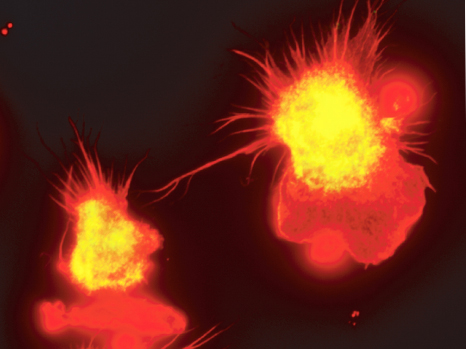
Macrophages

Cells in our blood feed, clean and defend our tissues, but their lifespan is limited. The life expectancy of a red blood cell rarely exceeds three months, our platelets die after ten days and the vast majority of our white blood cells survive only a few days.

The body must produce replacement cells in a timely manner. This is the role of hematopoietic stem cells, more commonly called blood stem cells. Nestled in the core of the bone marrow (the soft tissue in the center of long bones such as the chest, spine, pelvis and shoulder), they dump billions of new cells into the bloodstream every day. To accomplish this strategic mission, they must not only multiply but also differentiate, i.e. to produce specialized white blood cells, red blood cells or platelets.

For many years, researchers have been interested in how this process of specialization is triggered in stem cells. Michael Sieweke and his team previously discovered that the latter do not engage randomly in a particular differentiation pathway but “decide” their fate under the influence of internal factors and signals from the environment.

An important issue remains: how do stem cells manage to respond appropriately to emergencies? For example, are they able to meet the demand by producing white blood cells like macrophages to eat microbes during infection?

Until now, the answer was clear: the stem cells could not decode such messages and were content to differentiate randomly. Michael Sieweke’s team has demonstrated that, far from being insensitive to these signals, stem cell perceive them and in return manufacture the cells that are most appropriate for the danger that is faced.

“We have discovered that a biological molecule produced in large quantities by the body during infection or inflammation directly shows stem cells the path to take,” said Dr. Sandrine Sarrazin, Inserm researcher, co-author of the publication. “As a result of this molecule, called M-CSF (Macrophage Colony-Stimulating Factor), the switch of the myeloid lineage (the PU.1 gene) is activated and the stem cells quickly produce the cells that are best suited to the situation such as macrophages.”

Now that we have identified this signal, it may be possible in the future to accelerate the production of these cells in patients facing the risk of acute infection,” said Dr. Michael Sieweke, CNRS Research Director. “This is the case for 50,000 patients worldwide each year* who are totally defenseless against infections just after bone marrow transplantation. Thanks to M-CSF, it may be possible to stimulate the production of useful cells while avoiding to produce those that can inadvertently attack the body of these patients. They could therefore protect against infections while their immune system is being reconstituted”.

About the discovery

This seemingly simple discovery is quite original, both in its approach and by the technology it required. To reach their conclusions the team had to measure the change of state in each cell. This was a double challenge: the stem cells are not only very rare (there is only one stem cell per 10,000 cells in the bone marrow of a mouse), but they are also completely indistinguishable from their descendants.

“To differentiate the protagonists we used a fluorescent marker to indicate the status (on or off) of the myeloid cell switch: the protein PU.1. First in the animal, then by filming the accelerated cell differenciation under a microscope, we showed that stem cells “light-up” almost immediately in response to M-CSF,” said Noushine Mossadegh-Keller, CNRS assistant engineer, co-author of this publication. “To be absolutely sure, we recovered the cells one by one and confirmed that the myeloid genes were activated in all the cells that had turned green: once they perceived the warning message, they changed identity.”

A fish to detect contaminant endocrinal disruptors

The researchers from INERIS and Inserm (a team managed by Olivier Kah in Inserm unit 1085 “Institute for research into health, environment and work”) have just developed a test in fish that allows us to detect the endocrinal disrupting effects of certain contaminants in the environment. The researchers based their work on a gene that expresses in the brain, and that reacts strongly to certain endocrinal disruptors. In order to make it easier to measure this gene, they used a fluorescent reporter gene. By using the embryos of zebrafish that are transparent, we can see the effects in the brain when the embryos are exposed to disruptor pollutants. The results of these works are published in the review Plos One.

Fluorescence seen in the brain of the fish embryo, induced by the expression of gene cyp19a1b bound to the GFP.

Over the last 20 years, numerous studies have proved the harmful effects of artificial compounds on the reproductive capacity of organisms. Certain pollutants (nonylphenols, bisphenol A, pesticides, pharmaceutical residues, etc.) present in surface water, industrial waste or sediments are capable of mimicking the effects of oestrogens. They thus modify the biological processes that are controlled by oestrogens and are involved in the reproduction and growth functions of organisms, with potentially harmful consequences for the health of living creatures and their progeny. Such substances are known as “endocrinal disruptors” (ED).

Pollutants with oestrogen activity also affect the brain

The originality of the work carried out by the Inserm and INERIS researchers resides in the fact that the study of endocrinal disruptors concentrates on a gene that expresses only in the brain, and demonstrates the sensitivity of the nervous system to pollutants. The results obtained by the researchers confirm that in the fish embryo, a certain number of substances affect the activity of the stem cells in the brain, cells that are vital to the development of the central nervous system. This effect is seen in the expression of a specific gene in the brain that is extremely sensitive to oestrogens: gene cyp19a1b.

A zebrafish model to characterize ODs

Based on these observations, the INERIS and Inserm teams developed a test to detect oestrogen activity in a transgenic fish model. This transgenic zebrafish model (1) helps to identify the effect of pollutants on an enzyme from gene cyp19a1b, aromatase, that is responsible for the synthesis of oestrogens in the body.

The brain of the fish embryos uses a fluorescent reporter known as GFP (Green Fluorescent Protein), that renders it fluorescent when exposed to substances that mimic oestrogens.

21 components (e.g. natural or synthetic oestrogens; alkylphenols, bisphenols) of the 45 tested induced varying degrees of fluorescence. The metabolic capabilities of the model allowed us to detect substances such a certain androgens and certain synthetic progestatives (used in the contraceptive pill).

A test of this type is helpful in evaluating chemical substances, as required by the REACh (2) regulation. This tool is a complement to the existing in-vitro systems, and it has the advantage of integrating what will happen to pollutants in the body and of taking account of their metabolism, something than cannot always be done using tests on cells. Given its sensitivity, it could also be used to monitor aquatic environments.

The INERIS and Inserm researchers have finally opened up new prospects in the field of study of endocrinal disruptors in the central nervous system.

For the researchers themselves, it appears that this simple, robust and sensitive test will have many fields of application in assessing the risks implied in oestrogenic endocrinal disruptors.

Financed by the Ministry in charge of Ecology and the National Research Agency, the research undertaken by INERIS and Insert is aimed at pinpointing the ED potential of these chemicals, that are used in medication, cosmetics, phytosanitory products, plastics, etc.

About INERIS
The mission of the French National Institute for Environmental Technology and Hazards is to help to prevent hazards resulting from economical activities from affecting health, safety of persons and belongings, and the environment. It runs research programs aimed at better understanding the phenomena likely to lead to hazardous situations or dangers for the environment or health and developing its knowledge of prevention. Its scientific and technical know-how are made available to the state authorities, companies and local authorities so as to help them make the best decisions to improve environmental safety. Created in 1990, INERIS is a public commercial and industrial institute placed under the authority of the Ministry of the Ecology, Sustainable Development and Energy. It has a staff of 588 persons, based mainly in Verneuil-en-Halatte, in the Oise ‘département’. Website: www.ineris.fr.

About Inserm
Founded in 1964, the French National Health and Medical Research Institute (Inserm) is a public science and technology institute, jointly supervised by the French Ministry of Higher Education and Research and the Ministry of Health. The mission of its scientists is to study all diseases, from the most common to the most rare, through their work in biological, medical and public health research. Inserm support over 30à laboratories throughout France. In total, the teams include nearly 13,000 researchers, engineers, technicians and administrative staff, etc. Inserm is a member of the French Life Sciences and Healthcare Alliance, founded in April 2009 along with the CNRS (The French National Research Centre), CEA (Atomic Energy and Alternative Energy Commission), Inra (The National Institute for Agricultural Research), Inria (The French National Institute for Research in Computer Science and Control), IRD (The Institute for Research into Development), The Institut Pasteur, the Conference of University Presidents (CPU) and the Conference of Regional and University Hospital CEOs. This alliance forms part of the policy to reform the research system by better coordinating the parts played by those involved and by strengthening the position of French research in this field through a concerted plan.

Footnotes:

(1) In collaboration with Professor B.C. Chung of the Academia Sinica in Taiwan.

(2) Registration, Evaluation, Authorisation and Restriction of Chemical substances: European Parliament rule and directive No. 1907/2006 of December 18, 2006, concerning the registration, evaluation and authorization of chemical substances and the restrictions applicable to these substances.

(French) Progéria – Découverte du mécanisme moléculaire qui préserve les cellules neurales du vieillissement accéléré

Sorry, this press release is only available in French.

(French) Découverte d’une nouvelle règle d’organisation spatiale des chromosomes qui reflète leur fonctionnement

Sorry, this press release is only available in French.

New discovery of proteins involved in positioning muscular nuclei

The position of cellular nuclei in muscle fibres has an important role in some muscle weaknesses. Edgar Gomes, an Inserm researcher in the myology group at the Institute of Myology (mixed Inserm/UPMC unit) recently made this discovery in collaboration with an American team. The researchers identified several proteins involved in “correctly” positioning nuclei, which is required for the muscles to function. Their results are published in a letter in the Nature review, dated 18 March.

In order to move, living beings need muscles, and, more specifically, skeletal muscles that are controlled by the nervous system. Skeletal muscles are composed of cylindrical muscle fibres with a multitude of peripheral nuclei. Until now, little was known about the mechanism used to position nuclei on the edge of muscle fibres. A team of French-American researchers has tried to better understand the reasons behind nuclei layout.

Edgar Gomes and his team of collaborators have identified the mechanism involved in positioning nuclei in muscle fibres. The researchers identified (in Drosophila and mice) two proteins involved in positioning the nuclei: protein Kif5B, which belongs to the kinesin family (molecular motor), and protein MAP7, which is used to move different organelles (1) in cells.

This result was achieved by mutating MAP7 and Kif5b protein-coding genes in the Drosophila and by studying the development of the embryo. In this case, they observed that the nuclei were not correctly aligned in the muscle fibres.

MAP7 is required to position nuclei in muscle fibre in Drosophila and in mammals” states Edgar Gomes, Inserm researcher. The research team succeeded in describing the nuclei-positioning mechanism in fibres, which involved the MAP7 protein and its interaction with the molecular motor: kinsin Kif5b. They demonstrated that a mutation of these proteins did not affect muscle extension or its attachment to the skeleton: only the position of the nuclei was affected.

By making both proteins interact together, Edgar Gomes’ team suggest that MAP7 binds with Kif5b to encourage nuclei positioning. “Furthermore, these proteins act together, both physically and genetically, and their physical bond is required for correct nuclei positioning. Our results show that they are required for the muscle to function correctly” underlines Edgar Gomes.

Muscular diseases lead to weaknesses in the fibres and can be associated with a cellular nuclei alignment failure. Edgar Gomes and his team have demonstrated that by correctly replacing the nuclei, the muscle recovers its functions. “We suggest that by correcting muscular positioning faults in patients suffering from myopathies, these patients may see improvements in their muscular functioning” concludes Edgar Gomes.

Footnote

(1) Specialized structures in the cell contained in the cytoplasm

Comment sont sélectionnés les spermatozoïdes lors de la fécondation?

cp_arnoult_spermato27avr10

fig.-a-b-c-spermatozoïdes 27avr10

fermer